
When the Utah summer arrives, having a reliable cooling system is essential. If you’re exploring new air conditioning options, you’ve likely come across both heat pumps and ductless mini-split systems. Both can provide excellent summer cooling, but the better choice for your home depends on its layout, your existing equipment, comfort goals, and budget.
Many homeowners don’t realize that mini-split systems are a type of heat pump. In this comparison, “heat pump” usually refers to a ducted whole-home heat pump, while “ductless mini-split” refers to a ductless heat pump system that serves individual rooms or zones. Each option has unique advantages and limitations.
This guide will compare these two cooling solutions, looking at factors like performance, efficiency, installation, and comfort control to help you determine the best fit for your home.
What’s the Difference Between a Heat Pump and a Ductless Mini-Split?
At their core, both systems move heat from one place to another. During the summer, they absorb heat from inside your home and transfer it outdoors, leaving your indoor space cooler and more comfortable. This process is why modern heat pumps provide cooling so efficiently.
A ducted heat pump is a centralized system that connects to a network of ducts hidden in your walls, ceilings, or floors. An indoor air handler pushes the cool air through these ducts to vents in each room, providing consistent, whole-home temperature control.
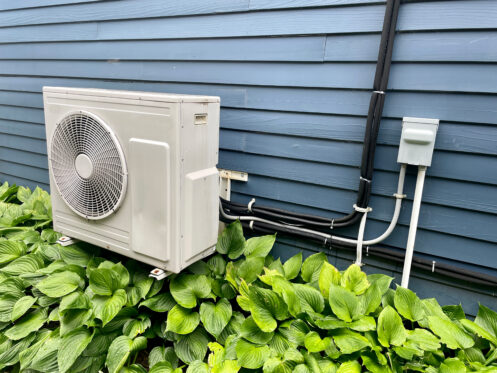
In contrast, ductless mini-split systems operate without any ductwork. The system consists of an outdoor compressor unit connected to one or more indoor air-handling units. These indoor units are typically mounted high on a wall or ceiling in the specific rooms or “zones” you want to cool. Each indoor unit delivers cool air directly into the space, offering targeted temperature control.
Which System Provides Better Summer Cooling?
When properly sized and installed, both traditional heat pumps and ductless mini-split systems can cool a home effectively. The best performer is one that matches your home’s unique characteristics and your family’s needs.
Several factors influence cooling results. The layout of your home, its insulation levels, and the condition of any existing ductwork all play a significant role. For example, a home with an open floor plan and well-maintained ducts is a great candidate for a central heat pump. A house with distinct rooms, a new addition, or poor ductwork might benefit more from the targeted approach of mini-split systems.
Room usage patterns are also important. If certain rooms are rarely used, cooling them with a central system can be inefficient. Mini-split systems allow you to cool only the spaces you’re using.
Does One Cool Faster Than the Other?
Mini-split systems may feel like they cool a space faster. Because the indoor unit delivers a direct stream of cold air into a specific room, you can feel the effects almost immediately.
A whole-home ducted heat pump offers balanced, gradual comfort. It brings the entire house to a set temperature and maintains that temperature evenly.
When Is a Heat Pump the Better Choice?
A ducted central heat pump is often the ideal solution in several scenarios. If your home already has a network of ductwork in good condition, a heat pump can be a straightforward and cost-effective upgrade. It allows you to use your existing infrastructure for both heating and cooling.
This option is also perfect for homeowners who want a single, centralized system for whole-home comfort. If you prefer uniform temperatures, a heat pump is an excellent choice.
- Consistent temperatures from room to room
- Simple control via a single, central thermostat
- A clean, unobtrusive aesthetic with only vents visible
- Complete, whole-home climate coverage
The main limitation is its reliance on ductwork. If ducts are leaky, poorly designed, or nonexistent, the system’s efficiency and performance can be compromised, potentially making a ductless option a better fit.
When Is a Ductless Mini-Split the Better Choice?
Ductless mini-split systems shine in situations where traditional ducted systems fall short. Their flexibility makes them perfect for specific comfort problems.
Do you have a second story that’s always warmer than the rest of the house? Or perhaps a room addition that isn’t connected to your central ductwork? In these cases, mini-split systems are a good option. Mini-splits can also work well for finished basements, garages, workshops, or other spaces that are difficult to connect to existing ductwork.
They are also a great choice for older homes without ductwork because they avoid the invasive process of retrofitting a duct system. Mini-split systems are also ideal for households where different family members have different temperature preferences.
- Zoned cooling for personalized comfort
- Highly flexible installation options
- Independent temperature control for each room
- No energy losses associated with ductwork
The primary drawback for some homeowners is the appearance of the indoor units. While modern designs are sleek and compact, these units are visible on the wall or ceiling.
Which Option Is More Energy Efficient?
Both modern heat pumps and mini-split systems are highly energy-efficient technologies. However, how that efficiency translates to your utility bills depends on your home and lifestyle. Mini-split systems often have an edge in efficiency due to their zone control capabilities. By cooling only the rooms you’re using, you avoid wasting energy on unoccupied spaces.
Furthermore, because mini-split systems don’t use ducts, they eliminate the energy losses that can occur from leaks or poor insulation in ductwork. However, today’s high-efficiency central heat pumps are incredibly effective at cooling an entire home with minimal energy use.
Can Zoned Cooling Reduce Utility Bills?
Yes, zoned cooling may help reduce utility bills, especially when you regularly avoid cooling rooms that are not in use. The ability to turn off or set back the temperature in unused rooms means your system runs less often and uses less energy. This benefit is greatest in larger homes or for households with varied schedules, where certain parts of the home are empty for long periods.
How Do Installation Requirements Compare?
For a central heat pump, the process is most straightforward in a home with existing ductwork. The project involves replacing the outdoor unit and the indoor air handler, which is often a seamless transition. If your home needs new ductwork, the installation becomes more complex and invasive.
Ductless mini-split installation is typically less disruptive. It requires mounting the indoor units and the outdoor compressor, and then connecting them with a small conduit that runs through a three-inch hole in an exterior wall.
Which System Offers Better Comfort Control?
The choice here comes down to personal preference. Ductless mini-split systems offer the ultimate in personalized comfort. Each indoor unit has its own thermostat, allowing you to set the living room to 72 degrees while a bedroom stays at 68. This level of granular control is perfect for families with different comfort needs.
A ducted heat pump often provides more consistent temperatures across the entire home. It eliminates significant temperature swings between rooms, creating a stable and uniform environment. With a single thermostat, it’s simple to operate and ensures every part of the house feels comfortable.
What Are the Long-Term Maintenance Considerations?
Both systems require regular maintenance to operate efficiently and reliably. For a ducted heat pump, this includes cleaning or replacing the central air filter every 1-3 months and having a professional perform an annual tune-up. Duct inspections may also be needed periodically to check for leaks.
For ductless mini-split systems, each indoor unit has a reusable filter that should be washed monthly. Like a central system, mini-split systems also need a professional annual tune-up to ensure the outdoor and indoor components are clean and functioning correctly.
Should You Choose a Heat Pump or a Ductless Mini-Split for Summer Cooling?
Neither system is universally better than the other. The best choice is the one that aligns with your home’s unique needs. A central heat pump is often the perfect solution for whole-home comfort, especially when quality ductwork is already in place.
On the other hand, ductless mini-split systems excel at providing targeted cooling, personalized zone control, and efficient solutions for hard-to-cool spaces or homes without ductwork. They offer flexibility that traditional systems can’t match. Before making a decision, consider your home’s layout, biggest comfort challenges, and long-term cooling goals.
The team at Blue Best Plumbing, Heating, Air, & Generators has over 20 years of experience helping homeowners find the perfect cooling solutions. If you need help deciding between these excellent options, contact your local AC company. Call Blue Best Plumbing, Heating, Air, & Generators for a personalized recommendation for your home in Bountiful, UT.