

HVAC Services in Coalville, UT
HVAC service in Coalville covers the full heating, cooling, and indoor air-quality stack for a Summit County mountain home that sits at roughly 5,580 feet of elevation along the I-80 corridor - a setting where overnight winter lows of -10°F to -25°F are a normal part of the season, where many homes still run on propane or fuel oil instead of natural gas, where wood-burning stoves routinely back up (or pre-date) the central system, and where a meaningful share of the housing stock is a second home or vacation property owned by Park City overflow buyers who need their HVAC running unattended for weeks at a time. Coalville is the Summit County seat, but with a year-round resident population near 1,400, the local HVAC engineering problem is more rural-mountain than small-town - closer to Wanship, Hoytsville, Echo, and Henefer than to anything on the Wasatch Front.
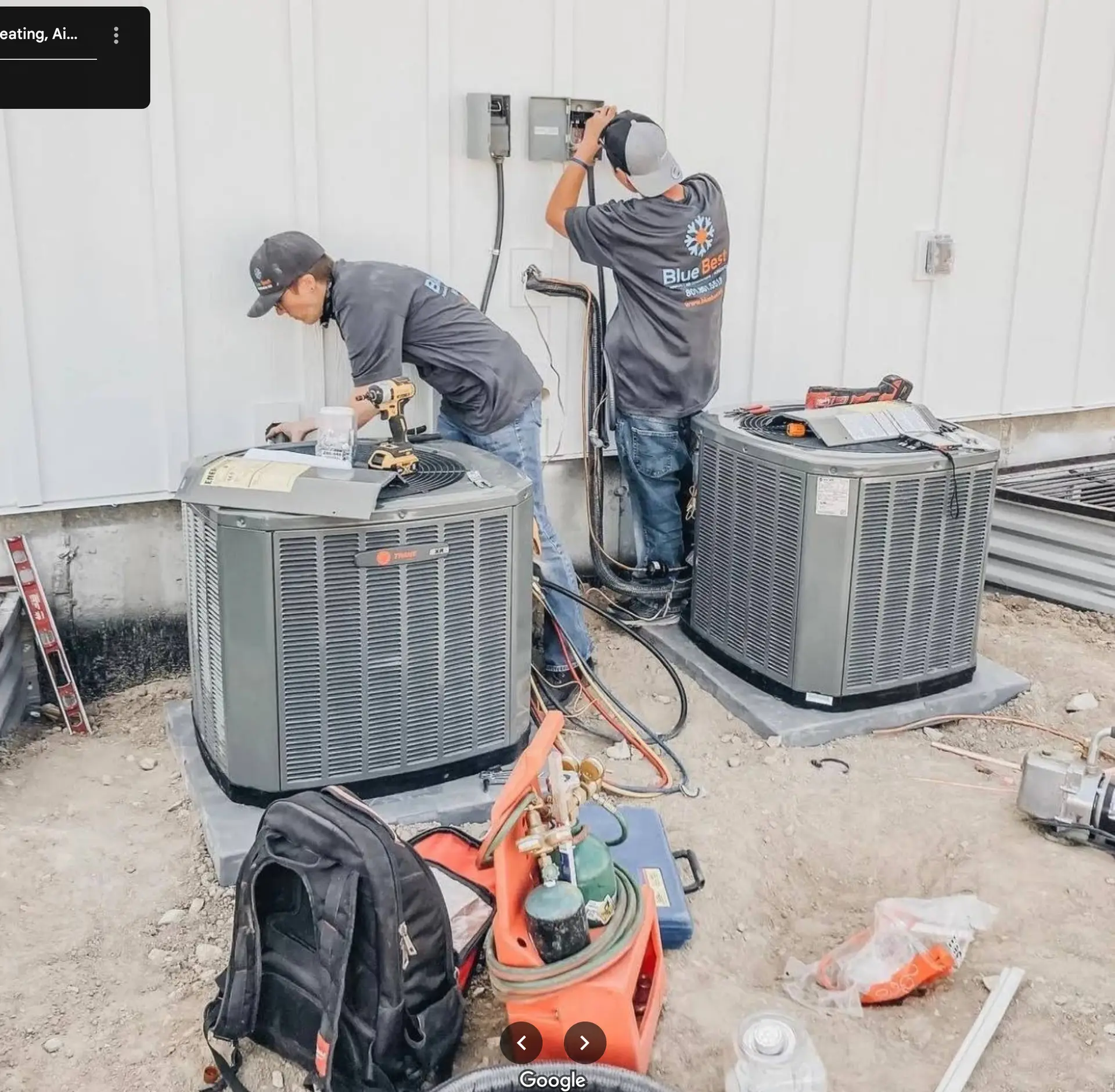
Blue Best Plumbing, Heating, Air & Generators is locally and women-owned and operated, BBB A+ accredited, and its team has spent more than 20 years on HVAC work along the Wasatch Front and the Wasatch Back. With 2,900+ five-star Google reviews, seven Best of State wins, Best of SLC honors (2024–2025), and factory authorization as a Lennox Premier Dealer, Bryant Authorized Dealer, Goodman Authorized Dealer, and Amana Platinum Dealer, our technicians work on every cold-climate platform a Coalville homeowner is likely to specify - Lennox SL25XPV cold-climate heat pumps, Bryant Evolution Extreme, Mitsubishi Electric Hyper-Heat mini-splits engineered to deliver useful output down to -13°F, propane and fuel oil furnaces, dual-fuel hybrid systems, and freeze-protection setups for absentee-owned cabins. Call 801-801-BEST (2378) or request a free in-home estimate through the form on this page.
HVAC service in Coalville covers the full heating, cooling, and indoor air-quality stack for a Summit County mountain home that sits at roughly 5,580 feet of elevation along the I-80 corridor - a setting where overnight winter lows of -10°F to -25°F are a normal part of the season, where many homes still run on propane or fuel oil instead of natural gas, where wood-burning stoves routinely back up (or pre-date) the central system, and where a meaningful share of the housing stock is a second home or vacation property owned by Park City overflow buyers who need their HVAC running unattended for weeks at a time.
CONTACT US
Why HVAC in Coalville Is a Cold-Climate, Off-Grid-Energy, and Absentee-Owner Problem
Coalville sits in a corner of Summit County where high elevation, deep mountain cold, mixed fuel sources, and a vacation-home demographic all push HVAC engineering well past what works in Bountiful or Park City proper. Five local realities shape every quote we write in Coalville and the surrounding Summit County valley.
5,580 ft elevation produces a combustion derate larger than anywhere on the Wasatch Front. Combustion-based heating equipment loses roughly 3–4% of rated AFUE output per 1,000 feet above sea level, which means a Coalville furnace is delivering closer to 78–82% of its nameplate BTU before any duct loss - roughly 20% off-sticker at this altitude. A 100,000 BTU/hr nameplate furnace at sea level effectively delivers 78,000–82,000 BTU/hr in Coalville. Most manufacturers require explicit high-altitude orifice kit changes above 4,500–5,000 ft, and the manufacturer's installation manual is the binding document. We size to the derated combustion output, not the nameplate, and we install the correct orifice kit on every applicable Coalville furnace. A surprising number of Coalville furnaces we inspect were sized and jetted as if the home were in Salt Lake.
Coalville winters are genuinely cold - and that changes the heat pump conversation. Coalville's winter design temperature runs around -5°F to -10°F, and most seasons produce a stretch of overnight lows between -15°F and -25°F. That's well past the operating range of a standard heat pump, which loses capacity below roughly 30°F and is functionally an electric resistance heater below 5°F. Modern cold-climate heat pumps (Lennox SL25XPV, Bryant Evolution Extreme, Mitsubishi Electric Hyper-Heat, Trane CGAM cold-climate, Lennox Z-Series) are a different category of equipment - Hyper-Heat units hold roughly 100% of rated capacity to 5°F and continue producing useful heat with a COP near 2.0 at -13°F and roughly 1.75 at -15°F outdoor ambient. That means a properly sized cold-climate heat pump is now a viable Coalville heating platform - either as a stand-alone all-electric system with electric-strip backup, or as the lead stage of a dual-fuel hybrid with the existing propane or natural-gas furnace covering the deepest cold snaps. We run the balance-point and gas-vs-electric breakeven math on every Coalville heat pump quote rather than reaching for a rule of thumb.
Many Coalville homes are off natural gas - the fuel conversation is real. Coalville sits inside the Dominion Energy service footprint for parts of town, but a meaningful share of homes - especially the rural-edge addresses out toward Hoytsville, Wanship, and the agricultural acreage along Chalk Creek - are on propane delivered from a yard tank, fuel oil from older installations, or all-electric heat. That changes the equipment math substantially. Propane runs roughly $25–$35 per million BTU delivered at current Utah propane rates, versus natural gas around $10–$15 per million BTU - so the dual-fuel and cold-climate-heat-pump cases are stronger in propane-heated Coalville homes than they are at the same altitude in Park City proper. Fuel oil is more expensive still and tends to be the strongest candidate for retirement during a system replacement. We handle propane furnaces, propane water heaters, propane-to-cold-climate-heat-pump conversions, and full fuel-source retirements with the same diagnostic and pricing rhythm as natural-gas equipment.
Wood-burning stoves are common as backup or primary heat - and they affect IAQ design. A significant share of Coalville homes - particularly older homes east of Main Street, ranch homes along Chalk Creek, and remote cabins toward Echo and Henefer - use a wood-burning stove or insert as supplemental winter heat (sometimes as primary, with the central furnace as backup). Wood stoves are warm, cheap to run if you cut your own wood, and a real source of indoor PM2.5, CO, and combustion-air conflicts with sealed-combustion modern furnaces. We design IAQ on Coalville homes with wood stoves in mind: dedicated combustion air for the wood stove that doesn't fight the furnace's intake, MERV 13+ media filtration on the central return to capture fine particulate, CO and low-level CO alarms in living spaces, and (where the budget supports it) an HRV or ERV running balanced fresh air to reduce indoor PM2.5 spikes during stove use.
Vacation properties and absentee-owner homes need a different HVAC service model. Coalville and the surrounding Summit County valley carry a steady share of second homes, vacation rentals, and absentee-owned cabins - Park City overflow buyers, family ranch retreats, summer cabins, and short-term rental properties along the I-80 corridor. The HVAC engineering problem there is freeze protection, not occupant comfort. A property that's empty for 6 weeks in February needs a minimum interior temperature of 50–55°F to keep domestic plumbing from freezing (and to keep finished interior framing from cycling through condensation), a smart thermostat with remote monitoring and freeze-alarm push notifications (Ecobee SmartSensor, Honeywell T10, or a Lennox iComfort), and ideally a freeze-stat low-temperature alarm wired into a cellular alert. We commission freeze protection on every absentee-owned Coalville home we service and schedule the spring and fall tune-up windows around owner travel rather than expecting them to coordinate from out of state.
Whether the call is a no-heat in single-digit January on a propane furnace, a wood-stove-and-central-system IAQ retrofit on an older Chalk Creek ranch home, a cold-climate Hyper-Heat conversion for an absentee-owned cabin out toward Henefer, or a planned full-system replacement on a year-round Coalville family home, the right starting point is a free in-home estimate. Call 801-801-BEST (2378) or use the form on this page.
Our HVAC Services in Coalville
Blue Best handles the full Coalville HVAC stack - heating-heavy in a 9-month-heating-season climate, with cold-climate heat pumps, propane and fuel-oil capability, and vacation-home freeze protection alongside the usual cooling and IAQ work. Pick the card that matches your situation.
Cold-Climate Heat Pumps & Dual-Fuel Systems
Cold-climate heat pump installation and dual-fuel hybrid systems engineered for Coalville's deep mountain winters. Modern variable-capacity units (Lennox SL25XPV, Bryant Evolution Extreme, Mitsubishi Electric Hyper-Heat) hold rated capacity to roughly 5°F outdoor ambient and continue producing useful heat with a COP near 2.0 at -13°F - viable for a Coalville winter floor in the -10°F to -20°F range with electric-strip or fuel-fired backup picking up the coldest 100–200 hours per year. Strongest pencil math in Coalville: replacing a propane furnace with a cold-climate heat pump + propane backup, which typically cuts annual heating spend 30–45% at current propane prices.
Propane & Natural Gas Furnace Repair & Installation
24/7 furnace repair, subject to availability, and full replacement on the propane, natural-gas, and (occasionally) fuel oil furnaces installed across Coalville. We size to the 5,580 ft altitude-derated load (~20% below nameplate), install the correct high-altitude orifice kit per the manufacturer's spec, and verify combustion analysis at commissioning. Common Coalville failures we run: hot-surface igniters, flame sensors, pressure switches, draft inducer motors, condensate-drain freeze-ups on sealed-combustion units in unconditioned crawlspaces, propane regulator faults, and oil-burner nozzle wear on the remaining fuel-oil installations.
Vacation Home & Absentee-Owner Freeze Protection
Engineered freeze-protection setups for second homes, vacation rentals, and absentee-owned cabins across Coalville, Wanship, Echo, Henefer, Hoytsville, and the I-80 corridor. We install smart thermostats with remote monitoring (Ecobee, Honeywell T10, Lennox iComfort), wire low-temperature freeze alarms into cellular-alert systems, commission minimum-setback schedules at 50–55°F interior temperature, and schedule spring/fall maintenance around owner travel. Most absentee-owner setups run $450–$1,200 depending on smart-thermostat ecosystem and alarm scope. Annual maintenance plans available with photo-documented service reports emailed to the owner after every visit.
Ductless Mini-Splits for Cabins, ADUs & Additions
Mitsubishi Electric Hyper-Heat and Fujitsu cold-climate multi-zone mini-splits for Coalville cabins, garage conversions, ADUs, bunkhouse outbuildings, and unconditioned additions where running new ducted supply through log walls or thick framing is impractical. Each indoor head is independently controlled, runs as low as 19 dB indoors, and Hyper-Heat units hold rated capacity to 5°F with useful output to -13°F - meaningfully more capable than the standard ductless equipment most contractors quote at lower altitudes.
AC Repair, Installation & First-Time Cooling
Many older Coalville homes have no central air conditioning at all - short, dry mountain summers historically didn't need it. As summers warm and as Park City overflow buyers renovate older Coalville housing stock to year-round comfort standards, first-time AC installs and retrofits are an increasing share of the work. We install Lennox, Bryant, Goodman, and Amana matched systems, verify the slight high-altitude capacity derate on the condenser side, and right-size to a real Manual J cooling load - not the rule-of-thumb a Wasatch Front contractor would use.
Indoor Air Quality (Wood-Stove Households)
Whole-home filtration (MERV 11–16 media cabinets), in-duct air purifiers (REME Halo, UV-C, PCO), CO and low-level CO alarms, whole-home humidifiers for the dry winter floor, balanced HRV/ERV ventilation, and wood-stove-compatible combustion-air design for the meaningful share of Coalville homes that burn wood as backup or primary heat. We design filtration to capture indoor PM2.5 from stove operation and to integrate cleanly with the home's existing fresh-air strategy. Standard wood-stove-household IAQ packages run $1,200–$3,500 depending on filtration tier and ventilation scope.
Why Coalville Homeowners Choose Blue Best for HVAC
Coalville's HVAC contractor pool is sparse - most local work is dispatched out of Park City or down off the Wasatch Front. Here's what differentiates a Blue Best engagement against the contractors most likely to be quoting alongside us in Summit County.

Cold-Climate Heat Pump, High-Efficiency Furnace, or Dual-Fuel? A Coalville Decision Guide
Three different right answers for a Coalville home, depending on your current fuel source, your home's envelope, and how cold the coldest night of the year actually gets at your address. Pick the box that matches your situation.
Dual-Fuel Hybrid (Cold-Climate Heat Pump + Furnace) - Most Common Coalville Answer
- ✓You currently heat with propane, natural gas, or fuel oil and want a meaningful drop in annual heating cost without giving up redundancy for the coldest nights
- ✓You want heat pump efficiency (COP 2.5–3.5) on shoulder seasons and on most winter days above roughly 15°F, with the existing or new furnace picking up the design-day cold snaps below the balance point
- ✓Your home is heated 9 months of the year and the fuel savings will pay back across hundreds of winter heating hours, not a handful
- ✓You want two independent heat sources so a single failure doesn't leave the property cold - critical for absentee-owned cabins and ranch homes
- ✓A dual-fuel install on a Coalville home replacing a 12-year-old propane furnace typically cuts annual heating spend 30–45% at current propane prices
All-Electric Cold-Climate Heat Pump (with Strip Backup)
- ✓You're building new, you're already on all-electric heat, or you're retiring an aging fuel-oil system and don't want another combustion appliance
- ✓Your home is tight and well-insulated - typically a post-2010 build or a high-quality retrofit with R-49+ attic and good window U-values
- ✓You want a single mechanical platform that handles heating and cooling year-round with one outdoor unit
- ✓You're comfortable with electric-strip backup picking up the handful of nights per year below the heat pump's effective floor (roughly -15°F to -20°F)
- ✓You're specifying a Mitsubishi Hyper-Heat, Lennox SL25XPV, Bryant Evolution Extreme, or equivalent cold-climate variable-capacity unit - not a standard heat pump
High-Efficiency Furnace (96%+ AFUE Standalone)
- ✓You're already on competitively priced natural gas (Dominion Energy footprint) and the dual-fuel pencil isn't strong enough to justify the heat pump premium
- ✓Your existing ductwork and combustion-air supply are in good shape - no major retrofit required
- ✓You want the lowest installed price on a replacement and the simplest possible long-term service profile
- ✓You're replacing only the furnace and don't currently have or need central AC
- ✓You're comfortable using a wood-burning stove as supplemental warmth on the coldest 20–40 nights of the year
What to Expect When You Call Blue Best for HVAC in Coalville
Coalville is a 50-minute I-80 drive from our Bountiful headquarters, so most Coalville work runs as a planned scheduled appointment with the travel built into the window - not an emergency dispatch. The rhythm of a typical visit is the same as anywhere on our route, with two Coalville-specific adjustments around fuel source and absentee-owner coordination.
Step 1
Schedule your visit
Call 801-801-BEST (2378) or fill out the form on this page. Planned consultations for replacement, new install, vacation-home setup, and seasonal maintenance are typically scheduled within 3–7 business days off-season and 5–10 business days during peak winter. For absentee-owned properties, we coordinate access through whatever system the owner prefers - lockbox, property manager, smart-lock code, or in-person handoff during their next Coalville visit.
Step 2
In-home diagnosis or assessment
Our technician inspects your existing system, identifies the fuel source (natural gas, propane, fuel oil, electric, or mixed), takes the measurements that matter (combustion analysis and gas pressure on furnace calls; refrigerant pressures and temperature split on cooling calls; static pressure, duct sizing, and blower amp draw on every replacement quote), notes any wood-burning stove in the home and its combustion-air arrangement, and checks for any freeze-protection or absentee-owner systems already in place.
Step 3
Engineered written proposal
For replacement and installation work, you receive a written scope that includes the 5,580 ft altitude-derated load calculation, equipment specification (model numbers, capacity, AFUE/SEER2/HSPF2, dB rating, AHRI matched-system certificate number), high-altitude orifice notes, balance-point and gas-vs-electric breakeven math on every heat pump and dual-fuel quote, fuel-source conversion scope where applicable, line-itemed pricing, and financing options. Good / better / best tiers quoted when sensible.
Step 4
Upfront flat-rate pricing - approved first
No work or equipment order proceeds until you approve the price. For absentee owners, sign-off can be remote (email, text, e-signature) - we don't expect the homeowner to be in Coalville to approve a quote.
Step 5
Repair, install, or freeze-protection work performed
Most repairs are single-visit because our trucks carry common HVAC parts (igniters, flame sensors, capacitors, contactors, blower motors, refrigerant, condensate pumps, common propane regulators and fittings). Full furnace or AC installs run 1–2 days; full system replacements with duct or fuel-conversion modifications run 2–4 days; dual-fuel heat pump conversions typically 2 days; freeze-protection and smart-thermostat commissioning a half day.
Step 6
Commissioning, walkthrough, and warranty registration
On installs we commission to manufacturer spec, run combustion analysis at altitude on furnaces, verify refrigerant charge by superheat/subcool on cooling and heat pump work, confirm static pressure across the new equipment, register the manufacturer warranty in your name, test freeze-protection alerts and remote monitoring end-to-end, and walk you through thermostat operation. For absentee owners we send photo-documented commissioning reports by email so you have a record without having to be on-site.
Step 7
Free first-season follow-up
Every install gets a complimentary first-season check-in (install a heat pump in fall, we revisit the following summer to verify cooling-side operation, and vice versa). Maintenance customers receive a written summary and a recommended next service interval. Absentee owners get a calendar-coordinated tune-up schedule that doesn't rely on them driving up from Salt Lake or flying in from out of state.
Honest HVAC Help Across Summit County - One Call Away
Whether your propane furnace just quit on a -10°F January night, you're specifying a cold-climate Hyper-Heat for a year-round Coalville family home, you need freeze protection commissioned on an absentee-owned cabin out toward Henefer, or you're finally retiring a fuel-oil system that's outlived its economics, Blue Best is one phone call and a 50-minute I-80 drive away.
HVAC Service Across Summit County and the Wasatch Back
We serve every Coalville-adjacent community in Summit and Wasatch County from our Bountiful headquarters. Same technicians, same Lennox Premier and Bryant Authorized expertise, same cold-climate engineering approach.
Frequently Asked Questions About HVAC in Coalville
HVAC costs in Coalville range widely by job type and fuel source. Common repairs run $175–$700 (igniters, flame sensors, capacitors, contactors, refrigerant top-off, pressure-switch replacement, propane regulator faults). Larger single-component repairs (compressor, evaporator coil, heat exchanger, ECM blower) run $1,400–$3,900. A full propane or natural-gas furnace replacement on a typical Coalville home runs $5,200–$11,500 installed; a cold-climate heat pump install runs $10,500–$18,500; a combined dual-fuel cold-climate heat pump + furnace install runs $13,500–$24,000; first-time central AC adds $5,800–$13,500; multi-head Mitsubishi Hyper-Heat mini-splits run $8,500–$22,000. Absentee-owner freeze-protection commissioning (smart thermostat + low-temp alarm + remote monitoring) runs $450–$1,200.
Yes - modern cold-climate heat pumps work in Coalville's winter, but the equipment selection has to be deliberate. A standard heat pump loses capacity below roughly 30°F and is essentially an electric resistance heater below 5°F - not a viable Coalville heating platform. A modern cold-climate variable-capacity heat pump (Lennox SL25XPV, Bryant Evolution Extreme, Mitsubishi Electric Hyper-Heat) is different equipment: Hyper-Heat units hold roughly 100% of rated capacity to 5°F and continue producing useful heat with a COP near 2.0 at -13°F outdoor ambient and roughly 1.75 at -15°F. Below the heat pump's effective floor (typically -15°F to -20°F depending on model), backup heat takes over - either electric strip or, in a dual-fuel setup, the existing or new propane/natural-gas furnace. For a Coalville home heated 9 months a year with overnight lows in the -10°F to -25°F range, a properly sized cold-climate heat pump covers 80–90% of annual heating hours efficiently, with backup picking up the remaining 100–200 hours.
The reliable answer is a smart thermostat with remote monitoring, a minimum interior setback at 50–55°F, and a low-temperature freeze alarm wired into a cellular alert. A minimum interior temperature of 50–55°F keeps domestic plumbing from freezing in interior walls, keeps drain traps from drying out, and prevents condensation cycling in finished framing. A smart thermostat (Ecobee with remote sensors, Honeywell T10, Lennox iComfort) gives you push notifications on your phone if interior temperature drops below the setpoint, plus a record of when the system is calling for heat. A low-temperature freeze alarm wired separately into a cellular alert (independent of the thermostat) is the belt-and-suspenders backup - most freeze losses in Coalville absentee homes come from a furnace failure that the thermostat alone doesn't catch in time. We commission the full setup, test the alerts end-to-end, and provide a written runbook for what to do when an alert fires. Most freeze-protection setups run $450–$1,200 depending on smart-thermostat ecosystem and alarm scope.
Yes. Blue Best serves every Summit County valley community accessible from I-80, including Coalville proper, the rural-edge addresses along Chalk Creek toward Hoytsville, Wanship at the I-80/US-189 junction, Echo and Henefer along the I-80 east corridor, the Echo Reservoir cabins, the Rockport Reservoir area, and the agricultural acreage that fills the spaces between. Dispatch from our Bountiful headquarters runs roughly 50 minutes via I-80 east. Most work is scheduled as a planned same-week or next-week appointment with the travel built into the appointment window - not the invoice. Call 801-801-BEST (2378).
Yes. Blue Best dispatches same-day emergency repair across Coalville and the surrounding Summit County valley from our Bountiful headquarters, including evenings and weekends. Our trucks carry common HVAC parts (igniters, flame sensors, capacitors, contactors, blower motors, refrigerant, condensate pumps, common propane regulators and fittings), so the majority of Coalville repair calls are completed in a single visit. Planned work (tune-ups, replacement consultations, freeze-protection commissioning) is scheduled into predictable Summit County windows. Call 801-801-BEST (2378).
Combustion-based heating equipment loses approximately 3–4% of rated AFUE output per 1,000 feet of elevation above sea level, so a Coalville furnace at 5,580 ft is delivering roughly 18–22% less BTU output than its nameplate suggests. A 96% AFUE furnace with a 100,000 BTU/hr nameplate effectively delivers 78,000–82,000 BTU/hr in Coalville. Most manufacturers require explicit high-altitude orifice kit changes above 4,500–5,000 ft - the manufacturer's installation manual for the specific model is the binding document. Blue Best sizes to the derated combustion output rather than the nameplate, and installs the correct orifice kit per the manufacturer's spec sheet on every applicable Coalville furnace. This is the single most common spec error we see on previously installed Coalville furnaces, and it shows up as a unit that runs almost continuously during a January cold snap and still can't hold setpoint.
Yes - propane-heated Coalville homes are the strongest pencil for cold-climate heat pump conversion in our entire service area. Propane runs roughly $25–$35 per million BTU delivered at current Utah propane rates, versus natural gas around $10–$15 per million BTU and electric heat-pump-equivalent heat around $15–$25 per million BTU at typical Rocky Mountain Power residential rates with a heat pump operating at COP 2.5–3.5. A cold-climate heat pump + propane backup on a Coalville home heated 9 months a year typically cuts annual heating spend 30–45% versus a propane-only furnace, with payback on the equipment premium running 5–9 years. We run the actual breakeven math on your home's specific fuel use and equipment quote - not a rule of thumb.
Yes, with a few specific design considerations. Wood-burning stoves are warm, cheap to run if you have your own wood supply, and a real source of indoor PM2.5 and CO during use - plus a potential combustion-air conflict with sealed-combustion modern furnaces and water heaters in the same building. Three things matter most. First, dedicated combustion air for the wood stove - a 4–6 inch outside-air supply ducted directly to the stove's intake so the stove doesn't pull combustion air from the same space the furnace is using. Second, MERV 13+ media filtration on the central return to capture fine particulate the stove releases into the room during loading and reload. Third, CO and low-level CO alarms in living spaces and bedrooms, plus consideration of a balanced HRV or ERV that exhausts stale air and brings in filtered fresh air during heavy stove use. Most wood-stove-household IAQ retrofits run $1,200–$3,500.
For most Coalville homes still running fuel oil, conversion makes sense at the next major service event. Fuel oil currently runs roughly $30–$45 per million BTU delivered in Utah - more expensive than propane and substantially more expensive than natural gas or a cold-climate heat pump operating at COP 2.5–3.5. Fuel-oil burners also require more frequent service (annual nozzle replacement, periodic chamber cleaning, tank monitoring), and the underground or above-ground tank itself eventually becomes a liability - soil remediation on a leaking underground tank is a five-figure problem. The strongest conversion paths for a Coalville fuel-oil home are typically (a) cold-climate heat pump + electric-strip backup if the envelope is tight enough, or (b) propane furnace + cold-climate heat pump dual-fuel if the heat pump alone can't carry the load. We quote both pathways alongside the like-for-like fuel-oil replacement so you can see all three numbers in writing before deciding.
Yes. Financing is available on qualifying installs and larger repair invoices (compressor, evaporator coil, heat exchanger, ECM blower, fuel-oil-to-heat-pump conversion), on approved credit; terms subject to change. Visit our financing page for terms and lender details, or ask your technician during your free in-home estimate.