

HVAC Services in Midway, UT
Midway is the Swiss village of the Wasatch Back - a town of roughly 5,500 residents founded by Swiss Mormon immigrants in 1859, tucked into the northwest corner of the Heber Valley at the foot of Wasatch Mountain State Park, organized around a Main Street of 1860s–1940s pitched-roof chalets, Old World gable barns, and travertine-block farmhouses, and globally identifiable for two things almost no other Utah town can claim: the annual Swiss Days festival every Labor Day weekend (continuous since 1947), and the Homestead Crater - a 55-foot travertine dome holding 90–96°F mineral hot springs circulating at roughly 135,000 gallons per day, the only warm-water scuba destination in the continental United States. Around that village core, a second Midway has grown up since 2000: luxury custom subdivisions like The Preserve, Burgi Hill, Crater Springs, and the golf-course corridor adjacent to Soldier Hollow Nordic Center (the 2002 Olympic biathlon and cross-country venue). The HVAC engineering problem in Midway is unlike anything else in Wasatch County - Swiss-heritage retrofits on 160-year-old buildings sitting alongside variable-capacity premium installs on $3M custom homes, with a genuine ground-source geothermal heat pump opportunity that exists almost nowhere else in Utah.
Blue Best Plumbing, Heating, Air & Generators is locally and women-owned and operated, BBB A+ accredited, and its team has spent more than 20 years engineering HVAC for the Wasatch Front and Wasatch Back. We treat Midway as the boutique village it actually is - not a generic Heber Valley suburb. Our technicians install and service the full equipment range a Midway address realistically specifies: Lennox SignatureCollection variable-capacity systems on Preserve and Burgi Hill luxury builds, Bryant Evolution Extreme cold-climate heat pumps at Midway's 5,580–5,800 ft elevation and -5°F to -10°F winter design temperatures, WaterFurnace / ClimateMaster / Bosch ground-source geothermal heat pumps in the Crater corridor where the underlying geothermal anomaly makes closed-loop sourcing genuinely viable, and sensitive heritage retrofits on Swiss-immigrant-era Main Street buildings where modern ductwork has to thread through 18-inch travertine walls and steeply-pitched chalet roof structures without compromising historic character. With 2,900+ five-star Google reviews, seven Best of State wins, Best of SLC honors (2024–2025), and factory authorization as a Lennox Premier Dealer, Bryant Authorized Dealer, Goodman Authorized Dealer, and Amana Platinum Dealer, we bring the equipment depth Midway's custom-home tier expects and the heritage discipline its Swiss-era buildings require. Dispatch from our Bountiful headquarters runs roughly 75–90 minutes via I-80 East and US-40 South (or UT-113 from the Park City side for our overflow Park City customers heading down into Midway). We tell you that math up front, build it into the appointment window. Call 801-801-BEST (2378) or request a free in-home consultation through the form on this page.
Midway is the Swiss village of the Wasatch Back - a town of roughly 5,500 residents founded by Swiss Mormon immigrants in 1859, tucked into the northwest corner of the Heber Valley at the foot of Wasatch Mountain State Park, organized around a Main Street of 1860s–1940s pitched-roof chalets, Old World gable barns, and travertine-block farmhouses, and globally identifiable for two things almost no other Utah town can claim: the annual Swiss Days festival every Labor Day weekend (continuous since 1947), and the Homestead Crater - a 55-foot travertine dome holding 90–96°F mineral hot springs circulating at roughly 135,000 gallons per day, the only warm-water scuba destination in the continental United States.
CONTACT US
Why Midway HVAC Is Genuinely Unique in the Wasatch Back
Midway is a small village (population ~5,500) with an outsized HVAC engineering footprint: Swiss-heritage architecture on 160-year-old buildings, a real geothermal heat pump opportunity in the Crater corridor, a luxury custom-home tier rivaling Park City, and a -5°F to -10°F winter design temperature at 5,580–5,800 feet of elevation. Six Midway-specific realities shape almost every quote we write here - and they're not the same as the realities five miles east in Heber City or six miles north in Park City.
The Homestead Crater anomaly creates a real geothermal heat pump opportunity - and it exists almost nowhere else in Utah. The Crater at Homestead is a 55-foot travertine limestone dome formed over roughly 12,000 years by ascending mineral-rich water that heated the local groundwater table along an active geothermal vent. Inside the dome, the spring holds 90–96°F mineral water at roughly 135,000 gallons per day, with a pool depth of 65 feet and a base diameter of 400 feet - the only warm-water scuba diving destination in the continental United States. The engineering significance for HVAC is that the broader Midway groundwater table runs measurably warmer than surrounding Wasatch Back communities, particularly along the Crater corridor that runs roughly from Homestead northwest toward the foothills of Wasatch Mountain State Park. That warmer source side dramatically improves the coefficient of performance (COP) on a closed-loop ground-source geothermal heat pump - typically pushing seasonal heating COP into the 3.5–5.0 range versus 3.0–4.0 on a conventional ground loop, with 40–60% lower seasonal operating cost than a natural-gas-plus-AC pairing. Geothermal isn't the right answer on every Midway address - small Old Town lots without yard space for a vertical or horizontal ground loop are usually a no - but on the larger Preserve, Burgi Hill, Crater Springs, and Wasatch Mountain-adjacent parcels, geothermal deserves real conversation that almost no Wasatch Back HVAC contractor will actually have with you. We specify, commission, and service the indoor unit (WaterFurnace, ClimateMaster, Bosch), integrate with existing forced-air or hydronic distribution, and partner with local well-loop drilling contractors on the buried portion.
Midway's Swiss-immigrant-era housing stock requires sensitive heritage retrofits, not generic ductwork. Midway was settled in 1859 by Swiss converts to the LDS church sent to the Heber Valley because the landscape reminded them of home, and the Swiss Days festival has run every Labor Day weekend continuously since 1947 as a celebration of that heritage. The architectural footprint is real and protected: pitched chalet roofs, wide eaves with carved bargeboards, decorative balconies, prominent stone-and-timber gable construction, and 18–24 inch travertine and quarried-stone walls on the oldest buildings along Main Street and around the historic town square. Retrofitting modern HVAC into a 1860s–1940s Swiss-heritage building is a different engineering problem than installing a system in a 2010 spec build. There's often no existing ductwork; running new ductwork through 18-inch stone walls is non-starter; chase routing has to thread through steeply-pitched chalet attics that aren't full-height; the homeowner usually wants to preserve plaster ceilings and carved exterior trim; and the building may have historic-character preservation expectations even when it's not formally landmarked. The right answer is almost always a high-wall or concealed-duct Mitsubishi Hyper-Heat or Fujitsu Halcyon mini-split system - independent of the original building envelope, minimal wall penetration, refrigerant lines that route through small chases or along exterior wall cavities, and each indoor head independently controlled. Heritage retrofits typically run $8,000–$22,000 depending on zone count and concealment level. We've done enough of this work across Heber Valley and Wasatch County that we know how to thread the engineering through the architectural constraints.
Altitude derate at 5,580–5,800 ft is real and shortens equipment life when ignored. Midway sits roughly 300–500 feet higher than the Wasatch Front cities of Salt Lake, Bountiful, and Centerville where most regional HVAC contractors do their design work. At that elevation band, combustion appliances lose roughly 20–22% of their nameplate BTU output due to thinner air - meaning a furnace rated at 100,000 BTU at sea level actually produces about 78,000 BTU at a Midway address. The fix is twofold: size the equipment 20–22% above what a sea-level Manual J says (we typically run 45–55 BTU/sq ft at Midway design conditions versus a 30–35 BTU/sq ft Wasatch Front rule of thumb), and install the manufacturer's high-altitude orifice kit on every gas-fired furnace with manifold pressure verified by combustion analyzer at commissioning. Skipping either step leaves the furnace running rich (incomplete combustion, soot buildup, premature heat exchanger failure) or undersized (continuous run on January nights, short-cycling on shoulder-season cool snaps, customer disappointment within 18 months). We do both as standard practice.
Midway's winter design temperature is colder than the Heber Valley average - closer to -10°F than -5°F. Midway sits in the northwest corner of the valley floor with clear-sky radiative cooling, frequent winter inversion patterns that trap cold air against the Wasatch foothills, and a microclimate that runs a few degrees colder on extreme January nights than Heber City five miles east. The honest 99% ASHRAE winter design temperature for Midway is closer to -10°F than -5°F, with overnight lows that touch -15°F to -20°F a few nights most winters. The heat pump engineering implication is that standard heat pumps lose useful capacity below 17°F and even cold-climate heat pumps need backup heat below their balance point. For a Midway property we typically specify either a Bryant Evolution Extreme or Lennox SignatureCollection cold-climate heat pump (rated capacity to 5°F, useful output to -13°F) paired with a dual-fuel gas furnace backup that switches over at the system's economic crossover point (typically 25–30°F at Midway gas-versus-electric pricing). Sizing a heat pump to Midway's actual design conditions - not to a borrowed Salt Lake design table - is the difference between a system that performs and a system that runs the resistance strip heaters every January night.
The luxury custom-home tier in Midway rivals Park City and demands premium variable-capacity equipment. Around the Swiss-heritage village core, Midway has grown a second housing tier since roughly 2000: The Preserve, Burgi Hill, Crater Springs, Stone Creek, and the Soldier Hollow / Wasatch Mountain State Park-adjacent custom-home corridor are full of $1.5M–$5M+ luxury builds with 5,000–10,000 sq ft floor plans, multiple HVAC zones, hydronic radiant floor heating, indoor pool and spa dehumidification scope, smart-home integration, and the design expectation of whisper-quiet variable-capacity operation. Premium Midway installs typically run $14,000–$26,000 for a single-zone luxury build and $28,000–$60,000+ for multi-zone whole-home variable-capacity scope on a 7,000+ sq ft home.
Park City overflow via UT-113 is real - and Midway is the value play. Midway sits roughly 15 minutes south of Park City via UT-113 (the "Burgi Hill cutoff") and has steadily become the value alternative to Park City real estate for buyers who want Wasatch Back lifestyle without the Deer Valley price floor. A meaningful share of our Midway customer base is Park City overflow - primary homes for families priced out of Park City Old Town and the Canyons, second homes for skiers who want closer access to Heber Valley golf and the Provo River, and rental investment properties on the UT-113 corridor that capture Park City visitor demand at a lower nightly rate. The HVAC engineering implication is that these buyers often arrive with Park City equipment expectations (premium variable-capacity, smart-home integration, remote monitoring for second-home gaps) on a slightly more rational budget than a Deer Valley spec build. We size accordingly: Park City equipment tier, Midway honest pricing, no premium-zip-code markup.
Whether the project is a Lennox SignatureCollection variable-capacity install on a new Preserve custom build, a WaterFurnace closed-loop geothermal heat pump commissioning on a Crater-corridor lot with ground-loop access, a sensitive Mitsubishi Hyper-Heat retrofit on a 1890s Swiss-heritage chalet on Main Street, or a routine fall tune-up on a long-time Midway family home in Town Square, the right starting point is a scheduled free in-home consultation. Call 801-801-BEST (2378) or use the form on this page.
Our HVAC Services in Midway, Utah
Blue Best brings the full HVAC stack to Midway addresses - engineered to a 5,580–5,800 ft elevation, a -5°F to -10°F winter design temperature, a Swiss-heritage architectural context on the village core, and a luxury custom-home tier on the surrounding subdivisions. Pick the card that matches your property.
Homestead Crater Corridor Geothermal Heat Pump Pairing
The signature Midway HVAC scope: specification, commissioning, and ongoing service of closed-loop ground-source geothermal heat pump systems on properties in the Crater corridor and the larger lots around The Preserve, Burgi Hill, and Wasatch Mountain State Park-adjacent custom homes. We install WaterFurnace 7 Series, ClimateMaster Trilogy, and Bosch Greensource indoor units, integrate with existing forced-air or hydronic radiant distribution, and partner with local well-loop drilling contractors on the buried ground loop. Geothermal heat pumps deliver 40–60% lower seasonal operating cost than a natural-gas-plus-AC pairing once installed. Total installed cost (indoor unit plus well field) typically runs $20,000–$40,000+ depending on loop type and home size.
Swiss-Heritage Retrofit Mini-Splits
Sensitive HVAC retrofits on 1859–1940s Swiss-immigrant-era buildings along Main Street, the historic town square, and the older blocks of central Midway - chalet-style homes, travertine-block farmhouses, restored barns, and small commercial-residential properties with 18–24 inch stone walls and steeply-pitched gable construction where traditional ducted forced-air retrofits are non-starters. Single-zone and multi-zone Mitsubishi Electric Hyper-Heat and Fujitsu Halcyon systems with high-wall or concealed-duct indoor heads, refrigerant lines threaded through small chases, and minimal exterior wall penetration. Hyper-Heat units hold rated capacity to 5°F with useful output to -13°F - a real heating answer for a Midway winter, not just a shoulder-season comfort upgrade. Heritage retrofits typically run $8,000–$22,000 depending on zone count and concealment level.
Premium Variable-Capacity Installs for Preserve, Burgi Hill & Crater Springs
Full-scope premium installs for The Preserve, Burgi Hill, Crater Springs, Stone Creek, and the Soldier Hollow / Wasatch Mountain State Park-adjacent custom-home corridor - the $1.5M–$5M+ tier of 5,000–10,000 sq ft homes where the equipment expectation is Lennox SignatureCollection SL25XPV variable-capacity heat pumps, Bryant Evolution Extreme cold-climate heat pumps, SLP99V modulating gas furnaces, multi-zone Ecobee SmartSensor or Lennox iComfort zoning, hydronic radiant floor integration, and indoor pool/spa dehumidification where applicable. Premium single-zone installs typically run $14,000–$26,000; multi-zone whole-home variable-capacity scope on a 7,000+ sq ft home runs $28,000–$60,000+.
Cold-Climate Heat Pump & Dual-Fuel Systems
Engineered heat pump installs for Midway's -5°F to -10°F winter design temperature at the 5,580–5,800 ft elevation band - typically Bryant Evolution Extreme or Lennox SignatureCollection cold-climate heat pumps (rated capacity to 5°F, useful output to -13°F) paired with a dual-fuel gas furnace backup that switches over at the economic crossover point (typically 25–30°F at Midway gas-versus-electric pricing). We calculate real balance-point math at your specific address, not a generic Wasatch Front crossover table, and we commission the changeover logic in writing. Heat pump installs qualify for Rocky Mountain Power Wattsmart heat pump rebates of $1,000–$2,000.
Second-Home & Park City Overflow Remote Monitoring
HVAC service engineered for the second-home and Park City overflow demographic that increasingly buys Midway real estate via the UT-113 cutoff - primary homes for families priced out of Park City, second homes for skiers who want Heber Valley golf and Provo River access, and rental investment properties on the UT-113 corridor. Smart thermostats with guest-friendly lockout ranges (Ecobee SmartSensor, Honeywell T10, Lennox iComfort), cellular freeze alarms for shoulder-season gap weeks, scheduled tune-ups timed to ski-season and golf-season transitions, and photo-documented service reports emailed to absentee owners after every visit. Standard tune-up packages run $89–$149; tune-up plus remote-monitoring commissioning runs $179–$249; full freeze-protection commissioning runs $450–$1,200.
Furnace & AC Replacement Across Midway's Village & Subdivision Mix
Full-system replacement for the post-2000 spec subdivision homes on the village edge - Town Square, the older Midway Meadows subdivisions, and the 1980s–1990s ranch-style infill - where the existing equipment is 18–25+ years old and the right answer is a mid-tier two-stage 96% AFUE furnace with 5,700 ft altitude-derated sizing and the correct high-altitude orifice kit installed and combustion-verified at commissioning, paired with a 16–18 SEER2 matched AC condenser. Mid-tier Midway replacements typically run $9,000–$15,000 installed.
Annual Maintenance for Midway's Recreation-Lifestyle Households
Spring and fall tune-up plans built around Midway's outdoor-recreation calendar - pre-ski-season fall visits coordinated with the Soldier Hollow Nordic season, post-Swiss Days tune-ups every September, mid-summer AC tune-ups before Wasatch Mountain golf season peaks, and combined visits that handle main-house plus pool-house or detached-guest-cottage scope on a single dispatch. The single biggest lifespan multiplier on any system installed at Midway elevation is correct altitude-derated sizing verified annually - mis-jetted equipment running at 5,700 ft short-cycles itself to an early grave regardless of brand.
Why Midway Homeowners Choose Blue Best Over Generic Heber Valley HVAC Shops
Several HVAC contractors will quote a Midway address. Most of them quote it like it's a Heber City suburb. Here's what differentiates a Blue Best engagement on a genuine Midway property.

Crater Corridor, Swiss-Heritage Building, or Preserve Custom Home? A Midway Property Decision Guide
Three different Midway property situations, three different right answers. Pick the box that matches your property and follow the link to the appropriate service.
Crater Corridor or Larger-Lot Midway Property - Ground-Source Geothermal Heat Pump
- ✓Your property sits in the Homestead Crater corridor, on The Preserve, Burgi Hill, Crater Springs, the Wasatch Mountain State Park-adjacent custom-home edge, or any Midway parcel with 0.5+ acres of yard space suitable for a vertical or horizontal ground loop
- ✓You're building new construction or doing a major equipment replacement on a $1.5M+ home and want 40–60% lower seasonal operating cost than a conventional gas-plus-AC pairing
- ✓Closed-loop ground-source geothermal delivers seasonal heating COP of 3.5–5.0 in the warmer Midway groundwater table, integrates with forced-air or hydronic radiant distribution, and routinely runs 20–25 years on the indoor unit plus 50+ years on the well loop
- ✓Total installed cost typically runs $20,000–$40,000+ depending on loop type, home size, and distribution integration
1860s–1940s Swiss-Heritage Building on Main Street or Town Square - Concealed Mini-Split Retrofit
- ✓Your home or small commercial-residential building is a Swiss-immigrant-era chalet, travertine farmhouse, restored barn, or carved-bargeboard heritage cottage on Main Street, the Town Square, or the older blocks of central Midway
- ✓The building has 18–24 inch stone walls, steeply-pitched chalet roof construction, no existing ductwork or wholly inadequate 1950s ductwork, and a historic character you don't want to compromise
- ✓Traditional ducted forced-air retrofits are non-starters because new chase routing through stone walls and steeply-pitched attics doesn't pencil out
- ✓A multi-zone Mitsubishi Electric Hyper-Heat or Fujitsu Halcyon mini-split system with high-wall or concealed-duct indoor heads is almost always the right answer - independent of the original building envelope, minimal wall penetration, refrigerant lines threaded through small chases
- ✓Heritage retrofits typically run $8,000–$22,000 depending on zone count and concealment level
Preserve, Burgi Hill, or Crater Springs Luxury Custom Home - Premium Variable-Capacity Install
- ✓Your home is in The Preserve, Burgi Hill, Crater Springs, Stone Creek, or the Soldier Hollow / Wasatch Mountain State Park-adjacent custom-home corridor - a $1.5M–$5M+ build of 5,000–10,000 sq ft with multiple HVAC zones and high finish expectations
- ✓You want whisper-quiet variable-capacity operation (Lennox SignatureCollection SL25XPV, Bryant Evolution Extreme, or equivalent), multi-zone smart-thermostat integration, hydronic radiant floor coordination where applicable, and AHRI matched-system documentation in writing
- ✓The system needs to handle Midway's actual -5°F to -10°F winter design temperature at 5,580–5,800 ft elevation - sized to 45–55 BTU/sq ft with high-altitude orifice kits and manifold pressure verified at commissioning
- ✓You're evaluating heat pump vs. dual-fuel vs. geothermal options and want honest balance-point math at your specific address rather than a generic recommendation
- ✓Premium single-zone installs run $14,000–$26,000; multi-zone whole-home variable-capacity scope on a 7,000+ sq ft home runs $28,000–$60,000+
What to Expect When You Call Blue Best for HVAC in Midway
Midway is the longest scheduled dispatch on our route - roughly 75–90 minutes from our Bountiful headquarters via I-80 East and US-40 South. Most Midway work runs as a planned scheduled appointment with that travel built into the window, and second-home properties run on a remote-coordination model. Here's the rhythm.
Step 1
Schedule with honest dispatch math - 75–90 minutes from Bountiful
Call 801-801-BEST (2378) or fill out the form on this page. We give you a real window from our Bountiful HQ: 75–90 minutes via I-80 East and US-40 South on a normal weekday (or via UT-113 from the Park City side if that's a more convenient route for our Park City overflow customers). Planned consultations are typically scheduled within 5–10 business days. For second-home owners, vacation-rental managers, and Park City overflow customers, intake can run entirely by phone and email - we don't need you in Midway to schedule the work or hand off site access.
Step 2
Property-type-specific walkthrough
Our technician walks the actual scope. For a Crater-corridor geothermal candidate, that means yard-space measurement for vertical or horizontal ground loop, groundwater table assessment, existing distribution audit (forced-air vs. hydronic), and electrical panel capacity verification. For a Swiss-heritage building, that means wall-thickness measurement, attic-chase routing assessment, photo documentation of historic character elements to preserve, and refrigerant-line path planning. For a Preserve or Burgi Hill custom-home replacement, that means static pressure on the existing system, combustion analysis on the existing furnace, multi-zone load distribution, hydronic radiant integration points, and a real room-by-room Manual J at -10°F design and 5,700 ft elevation.
Step 3
Engineered written scope with full rebate math
Within 24–72 hours of the walkthrough, you receive a written proposal that includes the load calculation summary, equipment specification (model numbers, capacity, AFUE/SEER2/HSPF2, dB rating, AHRI matched-system certificate number), high-altitude orifice notes and required manifold pressure, balance-point math on any heat pump or dual-fuel quote, geothermal COP and payback math where applicable, line-itemed pricing, financing options, and full rebate stacking: Rocky Mountain Power Wattsmart heat pump rebates of $1,000–$2,000.
Step 4
Remote sign-off for second-home owners - flat-rate pricing approved before work begins
No work or equipment order proceeds until you approve the scope and the price in writing. For second-home owners, Park City overflow buyers, and out-of-state custom-home builders, sign-off can be fully remote (email, text, e-signature) - we don't expect you to be in Midway to approve a quote, and we don't pad trip charges into the repair, layer diagnostic fees on top, or push surprise change orders mid-install.
Step 5
Scheduled service execution with combined-dispatch efficiency
Most repairs are single-visit because our trucks carry common HVAC parts. For Midway work specifically, we combine nearby addresses on the same dispatch day whenever we can - particularly useful for Park City overflow customers with multiple properties, Crater corridor neighbors coordinating geothermal installs, and HOA-coordinated subdivision tune-ups at Preserve or Burgi Hill. Furnace + AC installs typically run 1–2 days; Swiss-heritage mini-split retrofits run 1–3 days depending on chase complexity; full premium variable-capacity replacements run 2–4 days; geothermal indoor-unit commissioning runs 1 day after the well loop is in.
Step 6
Commissioning with altitude calibration, balance-point logic, and remote-monitoring activation
On installs we commission to manufacturer spec, run combustion analysis at 5,580–5,800 ft to verify manifold pressure and combustion efficiency on every gas furnace, verify refrigerant charge by superheat/subcool, confirm static pressure, validate balance-point switchover on dual-fuel systems, document geothermal entering and leaving water temperatures and COP at design conditions where applicable, and register the AHRI matched-system certificate and manufacturer warranty in your name. On second-home and Park City overflow installs, we activate the smart-thermostat ecosystem and cellular freeze-alarm, confirm the homeowner's phone receives test alerts, and configure guest lockout ranges before we leave the property.
Step 7
Scheduled visit cadence with photo-documented reports
Every Midway install gets a complimentary first-season check-in. Maintenance plan customers get the altitude-combustion calibration verified annually and geothermal loop performance trended year-over-year where applicable. Second-home owners, Park City overflow customers, and out-of-state buyers receive photo-documented service reports by email after every visit. Multi-property Park City overflow portfolios get scheduled Wasatch Back dispatch days so all of your Midway and Park City properties are handled in one efficient sweep.
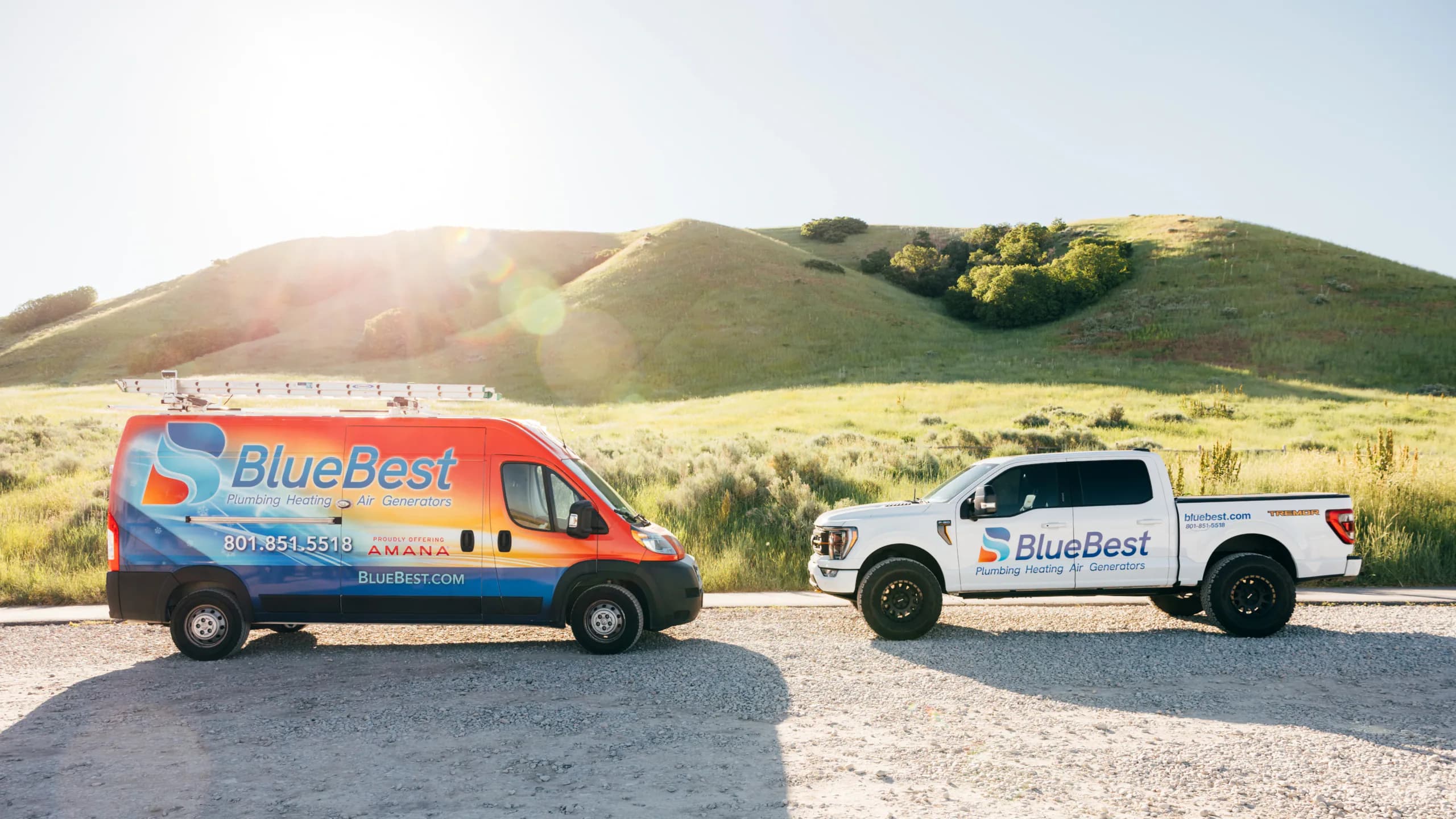
Midway HVAC, Engineered to the Village It Actually Is - Get Your Free Consultation
Whether you're commissioning a WaterFurnace geothermal heat pump on a Crater-corridor lot with closed-loop access, threading a concealed Mitsubishi Hyper-Heat retrofit through a 1890s Swiss-heritage chalet on Main Street, specifying a Lennox SignatureCollection variable-capacity multi-zone system on a new Preserve custom build, or rolling out remote-monitoring smart thermostats across a Park City overflow rental portfolio on the UT-113 corridor, Blue Best's team brings 20+ years of Wasatch Front and Wasatch Back HVAC engineering to the consultation.
HVAC Service Across Midway, the Heber Valley & Neighboring Wasatch Back Communities
We serve Midway as a distinctive Swiss-heritage village and engineer for it accordingly - and we serve every neighboring Wasatch and Summit County community from our Bountiful headquarters with the same technicians, the same Lennox Premier and Bryant Authorized expertise, and the same altitude-calibrated install discipline.
Frequently Asked Questions About HVAC in Midway, Utah
For the right property, genuinely yes - and Midway is one of the few Utah communities where geothermal deserves real conversation. The Homestead Crater holds 90–96°F mineral water circulating through a 12,000-year-old travertine dome at roughly 135,000 gallons per day, and the broader Midway groundwater table runs measurably warmer than surrounding Wasatch Back communities along the Crater corridor. That warmer source side pushes seasonal heating COP into the 3.5–5.0 range on a closed-loop ground-source geothermal heat pump (versus 3.0–4.0 on a conventional ground loop), with 40–60% lower seasonal operating cost than a natural-gas-plus-AC pairing. Geothermal isn't right for every Midway address - small Old Town lots without yard space for a vertical or horizontal loop are usually a no - but on Preserve, Burgi Hill, Crater Springs, and Wasatch Mountain State Park-adjacent parcels, it's a legitimate equipment path that almost no Wasatch Back contractor will actually have the conversation with you about. We specify, commission, and service the indoor unit (WaterFurnace, ClimateMaster, Bosch) and partner with local well-loop contractors on the buried portion.
Midway sits in the northwest corner of the Heber Valley floor at 5,580–5,800 feet of elevation, with clear-sky radiative cooling, frequent winter inversion patterns, and a microclimate that runs a few degrees colder than Heber City five miles east. The honest 99% ASHRAE winter design temperature for Midway is closer to -10°F than -5°F, with overnight lows that touch -15°F to -20°F a few nights most winters. Sizing matters because standard heat pumps lose useful capacity below 17°F - even cold-climate heat pumps need backup heat below their balance point. We typically specify either a Bryant Evolution Extreme or Lennox SignatureCollection cold-climate heat pump (rated to 5°F, useful output to -13°F) paired with a dual-fuel gas furnace backup that switches over at the economic crossover point (typically 25–30°F at Midway gas-versus-electric pricing). We run real balance-point math on your specific address rather than borrowing a Wasatch Front design table.
The luxury custom-home tier around the Swiss-heritage village core has grown substantially since 2000, and the equipment expectation on The Preserve, Burgi Hill, Crater Springs, Stone Creek, and the Soldier Hollow / Wasatch Mountain State Park-adjacent custom-home corridor is meaningfully above builder-grade. We typically specify Lennox SignatureCollection SL25XPV variable-capacity heat pumps or Bryant Evolution Extreme cold-climate heat pumps paired with SLP99V modulating gas furnaces running 65 stages of capacity modulation, multi-zone Ecobee SmartSensor or Lennox iComfort zoning, hydronic radiant floor integration where the home has it, and indoor pool/spa dehumidification where applicable. Premium single-zone installs run $14,000–$26,000; multi-zone whole-home variable-capacity scope on a 7,000+ sq ft home runs $28,000–$60,000+. Geothermal is increasingly common at this tier and worth real conversation if your lot has yard space for a ground loop.
No. Park City overflow into Midway is a real and growing demographic - primary homes for families priced out of Park City Old Town and the Canyons, second homes for skiers who want Heber Valley golf and Provo River access, and rental investment properties on the UT-113 corridor at lower nightly rates than Park City. Our pricing discipline is Park City equipment tier at Midway honest pricing - we don't apply a premium-zip-code markup to a Midway address just because the customer relocated from Park City or the property sits 15 minutes south of Deer Valley.
Yes - this is one of our most common Midway scopes. Swiss-immigrant-era buildings have 18–24 inch travertine and quarried-stone walls, steeply-pitched chalet roof construction, often no existing ductwork, and a historic character the homeowner usually wants preserved. Traditional ducted forced-air retrofits are non-starters. The right answer is almost always a multi-zone Mitsubishi Electric Hyper-Heat or Fujitsu Halcyon mini-split system with high-wall or concealed-duct indoor heads, refrigerant lines threaded through small chases or along exterior wall cavities, and minimal wall penetration. Hyper-Heat units hold rated capacity to 5°F outdoor ambient with useful output to -13°F - a real heating answer for a Midway winter. Heritage retrofits typically run $8,000–$22,000 depending on zone count and concealment level. We document existing historic-character elements before we start work and we route around them, not through them.
At Midway's elevation band, combustion appliances lose roughly 20–22% of their nameplate BTU output due to thinner air - meaning a furnace rated at 100,000 BTU at sea level actually produces about 78,000 BTU at a Midway address. The fix is twofold: size the equipment 20–22% above what a sea-level Manual J says (we typically run 45–55 BTU/sq ft at Midway design conditions versus a 30–35 BTU/sq ft Wasatch Front rule of thumb), and install the manufacturer's high-altitude orifice kit on every gas-fired furnace with manifold pressure verified by combustion analyzer at commissioning. Skipping either step leaves the furnace running rich (incomplete combustion, soot buildup, premature heat exchanger failure within 5–8 years) or undersized (continuous run on January nights, customer disappointment within 18 months). We do both as standard practice.
Dispatch from our Bountiful headquarters to Midway runs roughly 75–90 minutes via I-80 East and US-40 South (or via UT-113 from the Park City side for Park City overflow customers heading down into Midway). It's the longest scheduled drive in our service area. Planned consultations for replacement, new install, and seasonal maintenance are typically scheduled within 5–10 business days, with travel time built into the appointment window and never billed to you. The honest engineering truth is that scheduled fall tune-ups and freeze-protection commissioning prevent most emergency calls in the first place, which is why we strongly encourage planned-service rhythm for Midway properties - particularly for second-home and Park City overflow customers who aren't on-site to notice an issue developing.
Common repairs run $175–$700 (capacitors, contactors, igniters, flame sensors, refrigerant top-off). Larger single-component repairs (compressor, evaporator coil, heat exchanger, ECM blower motor) run $1,400–$3,900. Mid-tier two-stage furnace + matched AC replacement on a typical post-2000 Midway subdivision home runs $9,000–$15,000 installed. Swiss-heritage concealed mini-split retrofits on 1860s–1940s buildings run $8,000–$22,000 depending on zone count and concealment level. Premium variable-capacity multi-zone installs on Preserve, Burgi Hill, and Crater Springs custom homes run $14,000–$26,000 for single-zone luxury, $28,000–$60,000+ for multi-zone whole-home scope. Closed-loop ground-source geothermal heat pump systems in the Crater corridor run $20,000–$40,000+ installed (indoor unit plus well loop).