

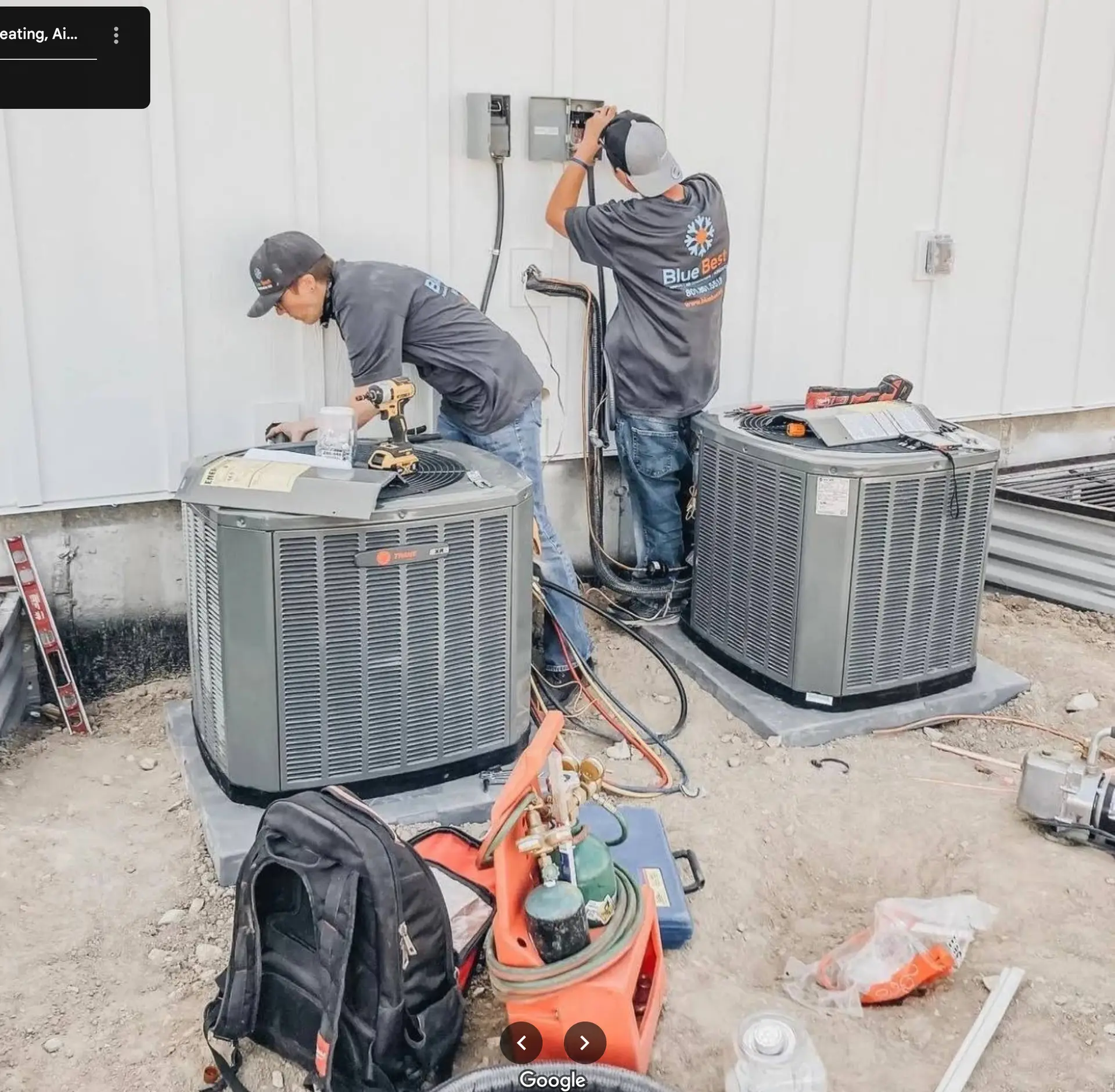

HVAC Services in Mapleton, UT
HVAC service in Mapleton covers the full heating, cooling, and indoor air-quality stack for a south Utah Valley agricultural-heritage city of roughly 12,000 residents wedged between Springville to the north and Spanish Fork to the south, climbing eastward from the valley floor onto the Maple Mountain Bench at the foot of the central Wasatch. Mapleton is genuinely different from every other Utah County hub we serve: it carries a stronger working-agricultural identity than Lindon, Pleasant Grove, Orem, or Provo - active horse properties, hobby ranches, working hay fields, and large 1–5 acre parcels are still the working norm here, not the exception. The city sits inside its own south Utah Valley microregion - cooler overnight lows than north Utah County, less I-15 corridor inversion than Salt Lake basin, and humidity effects from Utah Lake to the west that shape latent cooling loads through July and August differently than Lehi or Eagle Mountain. Housing stock breaks into historic Main Street and valley-floor farm-to-residential conversions at roughly 4,700 ft, post-2000 east-bench subdivisions climbing the Maple Mountain shoulder toward 5,300 ft, and a real custom foothill segment of 3,500–6,500 sq ft view homes overlooking the south Utah Valley toward Utah Lake. Layered on top: Maple Mountain afternoon downdrafts sweep west off the bench and route canyon-channeled debris through east-side condenser placements in ways that don't apply to Lindon (Battle Creek) or Alpine (American Fork Canyon).
Blue Best Plumbing, Heating, Air & Generators is locally and women-owned and operated, BBB A+ accredited, and its team has spent more than 20 years on HVAC work along the Wasatch Front. With 2,900+ five-star Google reviews, seven Best of State wins, Best of SLC honors (2024–2025), and factory authorization as a Lennox Premier Dealer, Bryant Authorized Dealer, Goodman Authorized Dealer, and Amana Platinum Dealer, our technicians install and commission the equipment Mapleton homes - and Mapleton outbuildings - actually run: Lennox Signature with iComfort, Bryant Evolution with Housewise, Carrier Infinity, Trane XV, Mitsubishi Hyper-Heat multi-zone mini-splits for barns, tack rooms, and detached shops, with smart-thermostat commissioning across Ecobee SmartSensor, Nest Learning, Honeywell T6 Pro, Apple HomeKit, Google Home, and SmartThings - every install commissioned to AHRI matched-system certification. From our Bountiful headquarters, Mapleton runs roughly 60–70 minutes via I-15 south through Point of the Mountain to the Springville / Mapleton exit - one of the longest scheduled dispatches in our entire service area, and we tell you that up front, build it into your appointment window. Call 801-801-BEST (2378) or request a free in-home consultation through the form on this page.
HVAC service in Mapleton covers the full heating, cooling, and indoor air-quality stack for a south Utah Valley agricultural-heritage city of roughly 12,000 residents wedged between Springville to the north and Spanish Fork to the south, climbing eastward from the valley floor onto the Maple Mountain Bench at the foot of the central Wasatch.
CONTACT US
Why Mapleton HVAC Has Specific Demands - South Utah Valley Microregion, Maple Mountain Foothill, Working Horse Property, Multi-Generational LDS Heritage, and a 60–70 Minute Dispatch
Mapleton reads on a map like "just another south Utah County town," but the agricultural identity, foothill exposure, microclimate, and lot pattern here line up in a combination we don't see anywhere else in our service area - including the smaller family towns north of Point of the Mountain. Six Mapleton-specific realities shape almost every HVAC sizing, equipment, and placement decision we make in this city.
Mapleton is the most agricultural-identity Utah County hub we serve - working horse properties, hay fields, and 1–5 acre parcels are still the working norm. Where Lindon, Pleasant Grove, and Cedar Hills have largely finished their transition from agricultural to suburban, Mapleton has not. The city was settled in the 1850s as a hay-and-orchard farming community on the south Utah Valley floor, and a substantial share of the original agricultural land base is still in active agricultural use today - working hay rotation, pasture for active horse operations, and unincorporated horse-property pockets with detached barns, tack rooms, riding arenas, and machine shops on 1 to 5+ acre parcels. The practical implication for HVAC consultations: a typical Mapleton appointment routinely includes a primary home (ducted central system) plus one or more detached structures - a 1,200 sq ft horse barn the owner wants to heat enough for foaling-season comfort, a 600 sq ft tack room where leather and saddle-soap conditioning needs climate-stable air, an 800 sq ft welding shop, a hay-storage outbuilding the family later finished as a workshop, or a mother-in-law casita on the back of a 2-acre lot. The right answer in these structures is almost never extending the central duct system 100 feet - it's a single-zone or multi-zone Mitsubishi Hyper-Heat or Fujitsu Halcyon mini-split sized to the actual space. Detached-structure HVAC work makes up a meaningfully larger share of Mapleton calls than it does in any other Utah County city we serve.
South Utah Valley is its own microregion - cooler nights, lower inversion, lake-driven summer humidity. Mapleton sits in the south Utah Valley microregion with a measurably different working climate than the I-15 corridor north of Point of the Mountain. Three concrete differences shape system sizing here: (1) overnight summer lows run 3–5°F cooler than Lehi, Lindon, or Orem on most July nights because the south Utah Valley drains cool air down off Maple Mountain, Spanish Fork Canyon, and the Mount Nebo shoulder - which makes night-setback and variable-capacity modulation more valuable in Mapleton because there's more daily temperature swing to capture; (2) winter inversion is real but materially less severe than the Salt Lake basin and even less severe than north Utah County, because the south Utah Valley sits at the open end of the basin and Spanish Fork Canyon vents east - IAQ filtration scoping is still important but doesn't need the heavy-inversion treatment we apply on Bountiful and central SLC installs; (3) Utah Lake humidity affects July–August latent cooling loads noticeably more than the north end of the valley, because prevailing afternoon winds drift lake-modified air east across Mapleton before draining back down the bench at sunset. We size to actual south Utah Valley design conditions - not generic Wasatch Front rule-of-thumb - and explain the microregion math on the consultation.
Maple Mountain foothill exposure and afternoon downdrafts shape outdoor-unit placement on east-bench installs. The east half of Mapleton climbs the Maple Mountain Bench from roughly 4,800 ft to over 5,300 ft depending on the address, and the foothill custom-home market here is real - 3,500–6,500 sq ft view homes oriented west toward Utah Lake sunsets, on 0.5–2 acre lots, with daylight basements and vaulted great rooms. Maple Mountain afternoon downdrafts route west off the bench every afternoon during the warm season, carrying scrub-oak debris, leaf litter, dust off the foothill scree, and grit into outdoor condensers on east-side placements. This is the same engineering category as Lindon's Battle Creek downdrafts and Alpine's American Fork Canyon exposure, but the geography is different - Maple Mountain is a broader bench-face exposure rather than a single canyon mouth, and the downdrafts hit the upper-Mapleton east-bench neighborhoods harder than the valley-floor blocks west of 1600 East. On east-bench foothill installs we pre-screen condenser placement for the wind-protected side of the home, recommend annual coil cleaning at minimum (twice yearly is better) above 5,000 ft, and clear a 24-inch service radius of decorative grasses and landscape rock that gets blown around in gusts. Valley-floor Mapleton installs west of 1200 East don't carry the same exposure - different placement logic, different maintenance cadence.
Elevation is two-tier in Mapleton - valley floor at 4,700 ft and east-bench foothill at 5,300 ft - and altitude derate is address-specific. The historic Main Street core, valley-floor neighborhoods west of 1600 East, and the older farm-to-residential conversions sit at roughly 4,700 ft elevation. The east-bench Maple Mountain foothill homes climb to 5,300 ft+ depending on the address - comparable in elevation to lower Alpine and East Lindon foothill, with similar combustion-derate implications. Combustion-based heating equipment loses roughly 3–4% of rated AFUE output per 1,000 ft of elevation, which means valley-floor Mapleton runs at roughly a 14% derate and a Maple Mountain foothill furnace at 5,300 ft runs closer to a 16% derate. Most manufacturer installation manuals require a high-altitude orifice kit change at 4,500–5,000 ft, which puts essentially every Mapleton furnace in scope. We size to the address-specific derated output, install the manufacturer-spec high-altitude orifice kit on every applicable Mapleton furnace, and verify combustion analysis at commissioning.
Multi-generational LDS family character with agricultural roots - different from Lindon's small-town-suburban family identity. Mapleton's family-oriented LDS character is well-established - the Mapleton Stake anchors the community, and a substantial share of Mapleton homeowners are second- and third-generation owners on land that came down through family from the original 1850s–1900s agricultural settlement. The practical implication is different from Lindon: where Lindon is a small-town family community with three distinct generational housing eras on standard lots, Mapleton is a multi-generational LDS family community with an agricultural heritage still actively running - working horse property, hay rotation, hobby ranches with active livestock, and detached agricultural outbuildings now finished as workshops, ADUs, or extended-family quarters. The HVAC consultation reflects that: we routinely talk through detached-structure mini-splits for a workshop where grandpa still rebuilds tractors, climate control for a tack room for the daughter's barrel-racing horses, or a casita for elderly parents who don't quite want the main house's thermostat schedule. We're scoping for the household pattern, not just the primary home's square footage.
Long dispatch from Bountiful HQ - 60–70 minutes via I-15 south, one of the longest in our service area. Mapleton sits roughly 60–70 minutes south of our Bountiful headquarters via I-15 in normal weekday traffic, exiting at the Springville / Mapleton exit on US-89 and routing east to the Mapleton city limits. That's one of the longest scheduled dispatches in our entire service area - meaningfully longer than the 45–55 minute Lindon run, longer than Lehi, and only matched by far-west Tooele County and far-north Box Elder calls. The southbound 5pm Point of the Mountain bottleneck routinely stretches that to 80+ minutes between 4:30pm and 6:30pm weekdays. We tell you that up front when you call, schedule Mapleton work in clusters with Springville, Spanish Fork, Salem, Payson, and south Utah Valley calls when the schedule allows (which is more efficient for us and meaningfully cheaper for you), and build the rush-hour delta into the ETA when same-day emergency calls require it. For most planned consultations, tune-ups, and mini-split estimates, we route 3–7 business days out as a planned south-valley appointment rather than a same-day call.
Whether the call is a Maple Mountain bench premium-tier variable-capacity replacement with downdraft-aware placement, a horse-property mini-split estimate for a working barn and tack room, a south Utah Valley microregion replacement on a 1990s east-bench tract home, a farm-to-residential conversion retrofit on an 1890s Main Street property, or a same-day no-heat emergency on a working agricultural address, the right starting point is a scheduled free in-home consultation. Call 801-801-BEST (2378) or use the form on this page.
Our HVAC Services in Mapleton
Blue Best covers the full Mapleton HVAC stack - heating, cooling, multi-zone design for east-bench foothill customs, mini-splits for working horse barns and detached shops, retrofit thinking for valley-floor farm-to-residential conversions, smart-thermostat integration, and indoor air quality engineered for Maple Mountain downdraft exposure and south Utah Valley microclimate. Pick the card that matches your situation and follow the link for full pricing, process, and FAQ detail.
AC Installation & Replacement
Premium-tier and mid-tier AC replacements across Mapleton, right-sized to the address-specific elevation derate (14% valley-floor at 4,700 ft, 16% east-bench at 5,300 ft) and to the south Utah Valley microregion design conditions - slightly cooler overnight lows than north Utah County, higher Utah Lake-driven latent cooling load in July–August. We install Lennox Signature SL25XPV, Bryant Evolution variable-speed, Carrier Infinity, Trane XV, and matched two-stage Lennox EL18XCV / Bryant Preferred systems with documented AHRI matched-system certification. Learn more about AC installation in Mapleton.
Furnace Installation & Replacement
Furnace replacement sized to the address-specific Mapleton altitude derate and quoted at the right tier for the home - premium variable-capacity Lennox Signature SLP99V or Bryant Evolution 987M at 98.7% AFUE for Maple Mountain east-bench foothill customs, mid-tier two-stage 96% AFUE for post-2000 east-bench subdivision replacements, entry-tier matched single-stage for valley-floor farm-to-residential conversions and 1990s Main Street area replacements, and matched-system AC pairings on every quote. Manufacturer-spec high-altitude orifice kits installed on every applicable Mapleton furnace. Learn more about furnace installation in Mapleton.
Ductless Mini-Splits for Horse Barns, Tack Rooms & Detached Shops
This is the signature Mapleton service - and the single biggest difference from neighboring Utah County hubs. Mitsubishi Electric Hyper-Heat and Fujitsu Halcyon single-zone and multi-zone mini-split installs for working horse barns, tack rooms, riding-arena warm-rooms, three-bay machine shops, RV garages, mother-in-law casitas, and finished agricultural outbuildings on Mapleton's 1–5 acre parcels. Each indoor head is independently controlled, holds rated heating capacity to roughly 5°F outdoor ambient, runs as low as 19 dB indoors, and requires no new ducted trunk runs to a structure 100 feet from the house. Learn more about ductless mini-splits in Mapleton.
Furnace & AC Repair
Diagnosis and repair on any brand of furnace, central air conditioner, heat pump, or multi-zone mini-split serving a Mapleton home or outbuilding. Common Mapleton failures we see weekly include condenser-fan bearing wear from Maple Mountain afternoon downdrafts on east-bench foothill installs, capacitor and contactor failures on post-2000 builder-grade equipment, pressure-switch fouling on agricultural-property installs near working hay rotation, and refrigerant leaks at line-set flares on mini-split barn installs that weren't pressure-tested at commissioning by the original installer. Most repairs are completed in a single visit at upfront flat-rate pricing approved before work begins. Learn more about furnace repair in Mapleton.
Heat Pumps & Dual-Fuel Systems
Cold-climate heat pump installation and dual-fuel hybrid systems for Mapleton homeowners with EV chargers, planned solar arrays, or a long-term decarbonization plan - common on east-bench foothill customs and on post-2015 subdivision homes. Variable-capacity cold-climate heat pumps (Lennox SL25XPV, Bryant Evolution Extreme, Carrier Infinity 24, Mitsubishi Hyper-Heat) hold rated capacity to roughly 5°F outdoor ambient, which covers most south Utah Valley winter days. Dual-fuel pairs a heat pump with a high-efficiency gas furnace as backup for the colder Maple Mountain foothill design-day nights. Learn more about heat pumps in Mapleton.
Multi-Zone Design for Maple Mountain Bench Custom Homes
Two-, three-, and four-zone ducted systems for the 3,500–6,500 sq ft east-bench foothill custom homes where a single thermostat routinely leaves a 4–6°F differential between the daylight basement, the west-facing main-floor great room oriented toward Utah Lake sunset view lines, the bonus room above the three-car garage, and the second-floor bedroom wing. Full Manual J room-by-room load calculation, Manual D duct sizing, Manual S equipment selection, matched to a variable-capacity Lennox Signature, Bryant Evolution, Carrier Infinity, or Trane XV condenser with proper zone-control board and modulating dampers. Outdoor placement pre-screened against Maple Mountain afternoon downdraft exposure.
Annual Maintenance & Comfort Club
Twice-yearly tune-ups (spring AC, fall furnace) at $89–$149 per visit - the documented annual professional service most manufacturer parts warranties require to remain valid. Comfort Club enrollment includes priority scheduling, no overtime fees on emergency calls, discounted repairs, twice-yearly outdoor coil cleaning on Maple Mountain east-bench installs exposed to afternoon downdraft debris, and filter cadence matched to working agricultural neighbors (shorter intervals on properties downwind of active hay rotation). Learn more about HVAC maintenance in Mapleton.
Why Mapleton Homeowners Choose Blue Best for HVAC
Mapleton is a small enough city that contractor reputations move through the Mapleton Stake, the school network, and the south Utah Valley horse-property community fast - and the working agricultural demographic here doesn't have patience for vague estimates, installers who never come back, or contractors who can't tell the difference between a primary home and a detached barn install. Here's where Blue Best differs in the field.

Common Mapleton HVAC Decisions
Three patterns we see week-in, week-out across Mapleton. If your situation matches one of these, here's how we'd typically scope it - and what we'd recommend before the in-home consultation.
Maple Mountain East-Bench Custom Home - Premium Variable-Capacity Multi-Zone With Downdraft-Aware Placement
- ✓Address profile: East-bench Maple Mountain foothill custom at 5,000–5,300 ft, 3,500–6,500 sq ft, post-2000 construction, 4–5 bedrooms with daylight basement, bonus room above three-car garage, west-facing main-floor great room oriented toward Utah Lake sunset view lines, exposed to Maple Mountain afternoon downdrafts
- ✓Recommended platform: Lennox Signature SLP99V variable-capacity furnace (98.7% AFUE) or Bryant Evolution 987M, paired with Lennox SL25XPV variable-capacity condenser or Bryant Evolution Extreme, full two- or three-zone ducted system with Lennox iComfort S30 or Bryant Housewise driving the modulation
- ✓Altitude work: Manufacturer-spec high-altitude orifice kit installed (required above 5,000 ft on most platforms), combustion analysis verified at commissioning, derated BTU sizing per address (~16% derate at 5,300 ft)
- ✓Downdraft-aware placement: Outdoor condenser sited on the wind-protected side of the home (typically north or west exposure away from the bench-face) to keep Maple Mountain afternoon downdraft debris off the coil face; 24-inch service radius cleared of decorative grasses and landscape rock that gets blown around in gusts
- ✓Typical investment: $12,000–$22,000+ for full matched-system replacement with multi-zone and smart commissioning
- ✓Rocky Mountain Power Wattsmart rebates typically apply
Working Horse Property With Detached Barn, Tack Room, or Shop - Mini-Split Project
- ✓Address profile: Mapleton agricultural or large-lot property on 1 to 5+ acres with a working horse barn, equestrian tack room, riding-arena warm-room, trainer's office, three-bay machine shop, finished hay-storage outbuilding, RV garage with welder setup, mother-in-law casita, or ADU that the main ducted system was never designed to reach
- ✓Recommended scope: Single-zone Mitsubishi Hyper-Heat or Fujitsu Halcyon ductless mini-split sized to the actual space - 9k BTU for a 400 sq ft tack room or office, 12–18k BTU for a 600–900 sq ft shop or finished barn area, 18–24k BTU for a 1,000–1,500 sq ft heated machine shop or full barn, multi-zone when more than one detached structure or zone needs independent control; line-set routing scoped to the actual structure-to-structure distance with a written quote on any extended-line-set premium
- ✓Why this answer: Mini-splits hold rated heating capacity to roughly 5°F outdoor ambient (well below typical south Utah Valley winter floors), require no new ducted supply or return trunk runs to a structure 100 feet from the house, run as low as 19 dB indoors (important in a tack room where horses can hear blower noise), and provide independent temperature control without competing with the main house's central system
- ✓Typical investment: $4,000–$8,000 for single-zone barn/shop/tack-room install; $8,000–$16,000 for multi-zone covering a barn + tack room + office, or shop + casita combinations
- ✓Rocky Mountain Power Wattsmart rebates typically apply on qualifying heat-pump-rated mini-splits
Older Farm-to-Residential Conversion or Pre-2000 Valley-Floor Home - Atmospheric Furnace Audit + Replacement Consult
- ✓Address profile: Pre-2000 valley-floor Mapleton home on or near historic Main Street, the original farm-to-residential conversions on the agricultural-grid blocks, or 1980s–1990s subdivisions south and west of 1200 East - 1,400–2,800 sq ft, often original 70–80% AFUE atmospheric or induced-draft furnace replaced once in the 1990s and now at system age 25–30 years on the original or 18–22 years on the first replacement, sometimes with smaller-than-modern duct trunks on the older conversions
- ✓Recommended scope: Full mechanical-room audit - combustion-air supply, vent stack, gas line size, electrical service, basement condensate path; Manual J load calculation sized to actual envelope (often 15–25% lower than the original installer assumed on a farm-to-residential conversion); two-tier replacement quote across a mid-tier Lennox EL296V two-stage 96% AFUE or Bryant Preferred two-stage with full PVC venting and combustion-air kit, alongside an entry-tier single-stage 95% AFUE option for budget-driven replacements
- ✓Altitude work: Sized to ~14% AFUE derate at 4,700 ft valley-floor Mapleton, high-altitude orifice kit installed where the manufacturer's spec sheet requires it
- ✓Typical investment: $8,000–$14,000 for mid-tier matched-system with full PVC venting and combustion-air retrofit; $6,500–$9,500 for entry-tier single-stage matched-system on a straightforward straight-swap address
- ✓Rocky Mountain Power Wattsmart rebates typically apply
What to Expect When You Call Blue Best for Mapleton HVAC
From the first call to a year after the install, here's the workflow Mapleton homeowners actually experience.
Step 1
Schedule by phone or web form
Call 801-801-BEST (2378) or use the form on this page. We confirm address (so we can map the Mapleton tier - valley-floor Main Street / farm-to-residential, post-2000 east-bench subdivision, or Maple Mountain bench foothill custom), equipment age and brand, whether the call involves a detached structure (working horse barn, tack room, riding-arena warm-room, machine shop, RV garage, casita), whether the home is still under manufacturer warranty, and whether the call is a planned consultation, scheduled tune-up, mini-split retrofit estimate, or no-heat / no-cool emergency. Most Mapleton consultations and tune-ups schedule 3–7 business days out - we route Mapleton work in clusters with Springville, Spanish Fork, Salem, and Payson calls when the schedule allows, which keeps drive cost down and your install cost competitive.
Step 2
Honest 60–70 minute dispatch transparency, 80+ minutes during 5pm Point of the Mountain rush
Mapleton is one of the longest scheduled dispatches in our service area, and the southbound 5pm Point of the Mountain bottleneck routinely extends our dispatch to 80+ minutes between 4:30pm and 6:30pm weekdays. We give you an honest window when you call, schedule mid-day appointments where we can, and build the rush-hour delta into the ETA when we can't. For genuinely critical no-heat or no-cool emergencies during rush hour, we'll tell you exactly what's possible - sometimes we can route a closer-positioned tech faster from a Utah County job in progress.
Step 3
In-home consultation, walkthrough, and structure audit
A Blue Best technician walks every floor of the primary home, walks any detached structure on the property (working barn, tack room, riding-arena warm-room, machine shop, RV garage, casita), takes static pressure on existing ductwork, runs combustion or refrigerant diagnostics where applicable, photographs the outdoor unit and notes Maple Mountain downdraft exposure if the home is on the east bench, reviews any existing smart-thermostat configuration, and on every post-2015 Mapleton home pulls equipment serial numbers through the manufacturer registration portal to verify remaining parts warranty.
Step 4
Mapleton City permit pull
Mapleton City mechanical permit is pulled on every install (typically $50–$200 depending on whether plan review is triggered and the equipment scope). We handle the paperwork; you don't.
Step 5
Service, install, or repair with full commissioning
Repair work is generally completed in a single visit because our trucks carry common HVAC parts (capacitors, contactors, igniters, flame sensors, blower motors, refrigerant, common mini-split control boards). Installation work runs 1–3 days depending on scope (single-stage replacement vs full multi-zone variable-capacity matched-system vs detached-structure mini-split vs farm-to-residential retrofit). We perform combustion analysis at commissioning on every gas-fired install, document AHRI matched-system certification, register the manufacturer warranty in the homeowner's name, and verify the smart-thermostat schedule, geofencing, and any zone controls work end-to-end after the install.
Step 6
Cleanup, walkthrough, and Comfort Club enrollment
Old equipment and packaging hauled away. We walk you through the smart-thermostat schedule, geofencing setup, filter replacement intervals (shorter on properties downwind of active hay rotation or working horse pastures), condensate drain location, and outdoor-unit coil rinse cadence - twice-yearly for Maple Mountain east-bench foothill installs exposed to afternoon downdrafts, annual for valley-floor installs west of 1200 East. Optional enrollment in the Blue Best Comfort Club for twice-yearly maintenance, priority scheduling, no overtime fees, and discounted repairs. One-year follow-up included.

Ready for Microregion-Specific, Downdraft-Aware HVAC Service in Mapleton?
Whether you're scoping a Maple Mountain east-bench foothill premium variable-capacity multi-zone replacement with proper afternoon-downdraft-aware outdoor placement, a mini-split estimate for a working horse barn and tack room on a 2-acre agricultural parcel, a south Utah Valley microregion replacement on a post-2000 east-bench subdivision home, a full audit-and-retrofit on a valley-floor farm-to-residential conversion still running a 1990s atmospheric furnace, or an honest second opinion on whether a 22-year-old furnace genuinely needs replacement this season, Blue Best's team brings 20+ years of Wasatch Front HVAC engineering and Utah County multi-generational agricultural-property experience to the consultation.
HVAC Service Across Mapleton and Surrounding South Utah Valley
Blue Best dispatches HVAC service from our Bountiful headquarters across the full Wasatch Front, with weekly Mapleton coverage routed in clusters through south Utah Valley. Below: Mapleton service detail pages, our nearby Utah County hubs, and financing. Mapleton service detail pages:
Mapleton HVAC FAQs
Normal weekday dispatch from our Bountiful HQ to Mapleton runs 60–70 minutes via I-15 south, exiting at the Springville / Mapleton exit on US-89 and routing east to the Mapleton city limits. Mapleton is one of the longest scheduled dispatches in our entire service area - meaningfully longer than the 45–55 minute Lindon run, longer than Lehi, and only matched by far-west Tooele County and far-north Box Elder calls. The southbound 5pm Point of the Mountain bottleneck routinely extends that to 80+ minutes between 4:30pm and 6:30pm weekdays. For most maintenance, tune-up, mini-split estimate, and consultation calls, we schedule 3–7 business days out and route Mapleton work in clusters with Springville, Spanish Fork, Salem, and Payson calls when the schedule allows.
Yes, materially. The historic Main Street core, valley-floor neighborhoods west of 1600 East, and the older farm-to-residential conversions sit at roughly 4,700 ft elevation. The Maple Mountain east-bench foothill homes climb to 5,300 ft+ depending on the address. Combustion-based heating equipment loses approximately 3–4% of rated AFUE output per 1,000 ft of elevation, which means a valley-floor Mapleton furnace runs at roughly a 14% derate and a Maple Mountain east-bench furnace at 5,300 ft runs closer to a 16% derate. Most manufacturer installation manuals require a high-altitude orifice kit change at 4,500–5,000 ft, which puts essentially every Mapleton furnace in scope. We size to the address-specific derated output, install the manufacturer-spec high-altitude orifice kit on every applicable install, and verify combustion analysis at commissioning.
Yes - and it's a real conversation we have on most Mapleton agricultural-property consultations. Homes directly downwind of active hay-cutting cycles, working pastures, or unimproved agricultural land see meaningfully higher pollen and airborne particulate loads during the late May through early September haying season than valley-floor subdivision homes shielded by suburban development. Two practical adjustments make a real difference: (1) upgrade from the 1-inch fiberglass or pleated filter slot to a 4–5 inch deep-pleat MERV 13 media cabinet - more surface area, lower pressure drop on the blower, and 6–12 month replacement intervals instead of the 4–8 week cadence a 1-inch filter actually needs downwind of working agriculture; (2) shorten outdoor coil rinse cadence on the Comfort Club schedule - twice-yearly is the right baseline on agricultural-adjacent Mapleton addresses, not annual.
For most Maple Mountain east-bench foothill custom floor plans, yes. A 4,500 sq ft home with a daylight basement, a west-facing main-floor great room oriented toward Utah Lake sunset view lines, a bonus room above the three-car garage, and four or five bedrooms running off a single thermostat routinely shows 4–6°F temperature differentials between zones - basement too cold in summer, upstairs bedrooms too hot in afternoon, sun-loaded great room running 3°F warm in late afternoon as the west wall takes full Utah Lake sunset load. The right answer is typically a two-zone or three-zone ducted system with a variable-capacity Lennox Signature, Bryant Evolution, Carrier Infinity, or Trane XV condenser matched to a proper zone-control board with modulating dampers. Each zone gets its own thermostat or Ecobee SmartSensor and runs independently. Multi-zone adds roughly $3,500–$8,000 to the equipment cost on a typical Maple Mountain bench replacement - and eliminates the single biggest comfort complaint we hear on 4–6 bedroom customs in this neighborhood.
Routinely - it's one of the most common Mapleton use cases we see. Mapleton's multi-generational LDS family character combined with the city's larger agricultural lots means a substantial share of homes here have finished basement apartments for elderly parents, mother-in-law suites for adult children temporarily home, detached casitas on the back of a 1–2 acre parcel, or ADUs converted from original agricultural outbuildings. We have two go-to scopes: (1) zone the existing ducted system with a properly sized zone-control board and modulating dampers so the basement apartment runs as an independent zone with its own thermostat, or (2) install a Mitsubishi or Fujitsu single-head or two-head ductless mini-split dedicated to the suite or detached casita, leaving the main central system to handle the rest of the household without competing for capacity. Path 2 is often the better answer when the suite is in a detached structure, has a separate entrance, separate occupancy schedule, or temperature preferences meaningfully different from the rest of the household.
Yes - this is one of the most common installs we run in Mapleton, and a Mitsubishi Hyper-Heat or Fujitsu Halcyon mini-split is almost always the right answer for a detached structure on a Mapleton agricultural lot. Mini-splits hold rated heating capacity down to roughly 5°F outdoor ambient (well below typical south Utah Valley winter floors), require no new ducted trunk runs from the main house, install with a refrigerant line set, condensate line, and a 240V circuit only, and run as low as 19 dB indoors - which matters in a tack room where horses can hear blower noise from the main barn. Typical Mapleton investment: $4,000–$5,500 for a single-zone 9k BTU install in a 400 sq ft tack room or trainer's office, $5,500–$7,000 for a 12–18k BTU install in a 600–900 sq ft shop or finished barn area, $6,500–$8,000 for an 18–24k BTU install in a 1,000–1,500 sq ft heated machine shop or full barn. Multi-zone systems covering a barn + tack room + office or shop + casita combinations typically land $8,000–$16,000. Most qualifying installs are eligible for Rocky Mountain Power Wattsmart rebates.
Maple Mountain afternoon downdrafts route west off the bench every afternoon during the warm season and carry scrub-oak debris, leaf litter, dust off the foothill scree, and grit into outdoor condensers on east-side placements above roughly 5,000 ft. This is the same engineering category as Battle Creek Canyon downdrafts in Lindon and American Fork Canyon exposure in Alpine, but the Maple Mountain bench is a broader downdraft face rather than a single canyon mouth - the exposure is more diffuse but covers more of the upper-Mapleton east-bench neighborhoods. Three habits matter most on east-bench installs: (1) annual coil cleaning at minimum, twice yearly is better above 5,000 ft; (2) clear a 24-inch service radius of decorative grasses, landscape rock, or shrubs that get blown around in gusts; (3) schedule a fan-blade balance and bearing inspection every 2–3 seasons because sustained downdraft conditions wear condenser-fan and inducer-fan bearings faster than valley-floor service intervals. Where placement is flexible on new installs, we site the outdoor unit on the wind-protected side of the home (typically north or west exposure, away from the bench face) - the same logic we apply on Alpine and East Lindon foothill installs.
Yes - three concrete differences shape sizing in Mapleton. (1) Overnight summer lows run 3–5°F cooler than north Utah County on most July nights because the south Utah Valley drains cool air off Maple Mountain, Spanish Fork Canyon, and the Mount Nebo shoulder - which makes night-setback schedules and variable-capacity modulation more valuable in Mapleton because there's more daily temperature swing to capture and convert to Rocky Mountain Power savings. (2) Winter inversion is real but materially less severe than the Salt Lake basin and even less severe than north Utah County because the south Utah Valley sits at the open end of the basin and Spanish Fork Canyon vents east - IAQ filtration is still important but doesn't need the heaviest-inversion treatment. (3) Utah Lake humidity affects July–August latent cooling loads noticeably more than the north end of the valley because prevailing afternoon winds drift lake-modified air east across Mapleton before draining back down the bench. A variable-capacity AC with proper dehumidification control handles the south-valley latent load meaningfully better than a single-stage system.
Common Mapleton ranges, quoted at upfront flat-rate before work begins: entry-tier matched-system (Lennox Merit ML195 single-stage or Bryant Legacy equivalent + matched 14.3 SEER2 condenser, common on valley-floor farm-to-residential conversions and 1990s Main Street area homes) lands around $6,500–$9,500 installed; mid-tier two-stage matched-system (Lennox EL296V 96% AFUE + EL18XCV 18 SEER2, or Bryant Preferred two-stage equivalents, common on post-2000 east-bench subdivision replacements) lands around $8,000–$14,000 installed; premium variable-capacity matched-system (Lennox SLP99V 98.7% AFUE + SL25XPV with iComfort, or Bryant Evolution 987M + Evolution Extreme with Housewise, common on Maple Mountain bench foothill customs) lands around $12,000–$22,000+ depending on home size, zone count, east-bench altitude work, and downdraft-aware placement scope. Detached-structure mini-splits for working horse barns, tack rooms, and shops run $4,000–$8,000 for single-zone, $8,000–$16,000 for multi-zone. Multi-zone on the primary home adds roughly $3,500–$8,000 to equipment cost. Annual maintenance runs $89–$149 per visit. Rocky Mountain Power Wattsmart rebates typically apply. Mapleton City building permit runs $50–$200 depending on plan review.
A correctly sized, AHRI matched-system, correctly installed Mapleton HVAC system should run 15–20+ years on the furnace, 12–17 years on the central AC condenser, and 12–15 years on a cold-climate heat pump - assuming annual maintenance and the right address-specific altitude / orifice spec on the combustion side. Maple Mountain east-bench condensers sometimes show fin wear a year or two earlier than valley-floor installs because of afternoon downdraft debris and ridge-line sun load; valley-floor Mapleton installs west of 1200 East typically run the full design life without that accelerated wear, especially when twice-yearly coil rinse is on the Comfort Club schedule. Detached-structure mini-splits in working horse barns and shops often outlast central-system equipment because they run lower duty cycles and stay relatively dust-protected indoors. Premium variable-capacity equipment generally outlasts single-stage at the same age because it runs at lower load most of the time - less thermal cycling, less compressor wear, longer service life.