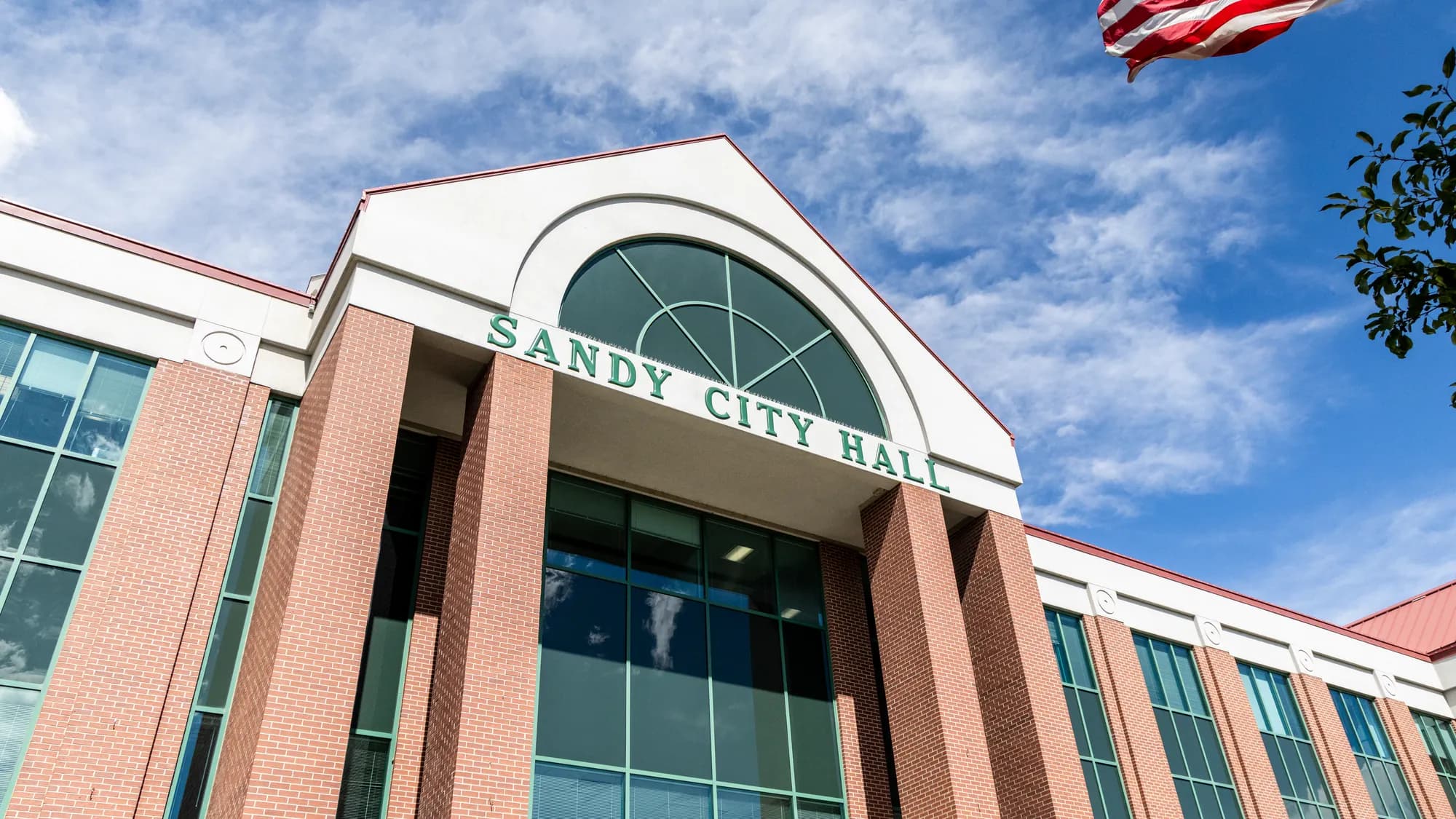
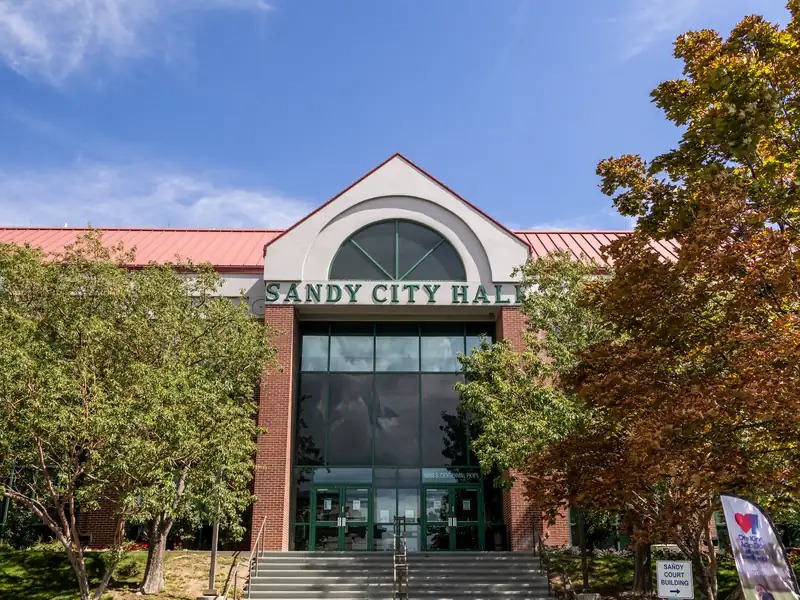
Sandy, Utah · Salt Lake County · incl. White City & Granite
HVAC, Plumbing & Generators in Sandy, UT
Women-owned, 5.0-rated home services for Sandy, a city that climbs from the valley floor to nearly 5,000 feet at the mouth of Little Cottonwood Canyon. Bench elevation changes how systems should be sized, water hardness changes by zone, and the 1970s–90s housing stock is hitting replacement age. We work to your address, not a valley average.
Get a Free Sandy Estimate
Quick Answer
Yes, Blue Best provides HVAC, plumbing, water treatment, water heaters, generators, and indoor air quality service throughout Sandy (including White City and Granite), with same-day service usually available, subject to scheduling. Our work accounts for Sandy's specifics: bench elevation to ~5,000 ft, zone-varying hard water we measure at your home, and a 1970s–90s housing cohort at replacement age.
Who is the best HVAC & plumbing company in Sandy, UT?
Blue Best is Sandy's highest-rated full-service home company, a 5.0-star rating across 2,900+ verified Google reviews, seven Best of State awards, a Nextdoor Neighborhood Fave (2022–2025), and locally and women-owned and operated since 2020, run from a Bountiful headquarters [1]. What sets the work apart here isn't a slogan: it's knowing that Sandy's official water report publishes no hardness number while the real figure swings from 8 to 25 grains per gallon by zone, that the city climbs from about 4,450 feet near State Street to nearly 5,000 feet on the east bench toward Bell Canyon, a 5–8% AC derate that sizing has to respect, and that all of Salt Lake County sits inside the EPA's Serious Northern Wasatch Front ozone area, where the 1970s–90s housing stock is hitting replacement age all at once. The industry averages a 4.2 rating, and Utah has more than 1,500 HVAC contractors competing for it, the highest contractor-to-population ratio in the country [2], which makes a perfect score across thousands of reviews the signal it is. Written prices before work and a free second opinion on anyone else's quote.
[1] Rating and review count per Blue Best's Google Business Profile: data-sources. [2] Industry-average and contractor-density context: data-sources.
How does Blue Best compare to other Sandy contractors?
When a Sandy homeowner is weighing quotes, the differences that matter aren't in the brochure, they're in how the work actually gets priced, staffed, and stood behind:
 | The typical contractor | |
|---|---|---|
| Pricing | ✓ Flat-rate, quoted in writing before any work begins | Hourly or vague estimates; the number moves at the end |
| Who shows up | ✓ W-2 employees, background-checked - never subcontractors | Subcontractors or rotating crews |
| Repair or replace | ✓ Service calls go to sales only when repair isn't viable, and our technicians aren't paid commission to decide otherwise | Routine service calls turned into replacement sales pitches |
| Credentials | ✓ Utah-licensed & insured, $1M+ liability | Varies; not always verifiable |
| Ownership | ✓ Locally and women-owned and operated · 7× Best of State · decades of combined experience | Often out-of-area or a franchise |
| After the job | ✓ Workmanship guarantee + membership support a call away | Hard to reach once the invoice clears |
What home services does Blue Best offer in Sandy?
Get StartedHVAC repair & install
AC, furnace, heat pump, ductless, sized for your bench elevation.
Plumbing & drains
Leaks, fixtures, repipes, drain clearing.
Water heaters
Tank, tankless, heat-pump, scale management for hard zones.
Water treatment
Softeners sized to your measured hardness, not a city guess.
Whole-home generators
Briggs & Stratton standby power for canyon-wind outages.
Indoor air quality
MERV-13 filtration and ventilation for inversion season.
Is Sandy's hard water quietly destroying your pipes and water heater?
Here's something most companies won't tell you: Sandy's official water report doesn't publish a hardness number, hardness isn't a federally required analyte, and our June 2026 read of the city's report confirmed it's silent [1]. What system reports and zone observations show is a wide band: roughly 8 to 25 grains per gallon depending on zone and season [1].
A range that wide means a softener sized to a "city average" is wrong for half the city. So we do it the only honest way: we test your actual hardness at your home, free, before recommending anything, then size equipment to the measurement.
[1] Sandy City CCR (read June 2026, hardness not published); zone band per system reports and third-party measurements. Methodology: data-sources.
Is Sandy's Serious-ozone valley air putting your family and HVAC at risk?
Salt Lake County sits, whole county, in the EPA's Northern Wasatch Front ozone nonattainment area (currently classified Serious; an EPA reclassification proposal is pending) [1]. The particulate story improved: the county's PM2.5 designation reached attainment in December 2025 after 15 years [1]. Winter inversions still pool fine particles in the valley, Sandy's upper bench sometimes rides above the worst haze, but nobody escapes ozone season. MERV-11 to MERV-13 filtration captures what builder-grade filters pass through.
[1] EPA Green Book, Utah (verified June 2026). See data-sources.
How does Sandy's bench elevation change your HVAC?
The nearest verified NOAA station, Salt Lake City International, logs 5,154 heating degree days and 1,420 cooling degree days a year (1991–2020 normals) [1]. But Sandy isn't the airport: the city climbs from roughly 4,450 feet near State Street to nearly 5,000 feet along the east bench toward Bell Canyon. Three practical consequences:
- •AC capacity: thinner air trims 5–8% off sea-level ratings, bench homes need elevation-adjusted sizing.
- •Cooler, swingier bench: upper-bench evenings run cooler with bigger daily swings than the valley floor, affecting both comfort settings and equipment choice.
- •Canyon winds: Little Cottonwood's outflow winds stress outdoor units and knock out power on the upper east side, why standby generators are a steady Sandy request.
[1] NOAA NCEI 1991–2020 normals, SLC INTL AP (USW00024127), verified. Elevations: USGS GNIS (approx.). See data-sources.
What kind of homes does Sandy have?
Sandy (about 91,000 residents [1]) was largely built out in the 1970s–1990s suburban waves, which puts a huge share of its systems at or past replacement age:
- •1970s–80s core, second- and third-cycle systems, R-22 air conditioners, and ductwork sized for milder summers than we get now.
- •1990s east-side growth, first-replacement window now; builder-grade equipment aging out.
- •Bench premium homes, Pepperwood, Bell Canyon-area, Dimple Dell rim: larger multi-zone systems, wind exposure, generator demand.
- •Historic Sandy, the original town grid near Main Street: older homes with retrofit challenges and character worth preserving.
Sandy grew up in the 1870s as a railroad and smelting stop for ore coming out of Little Cottonwood Canyon. The Sandy Historic District, roughly between State Street, 9000 South and 700 East, still holds older homes with masonry, narrow framing, lath-and-plaster walls and low ceilings.
Across the 1970s-90s tract homes, undersized returns are common, and oversized equipment on undersized ductwork is a common cause of noise, short-cycling and early failure.
[1] US Census/2026 estimates. See data-sources.
Sandy neighborhoods we serve
White City and Granite are their own communities, both core Blue Best coverage served through our Sandy routes. Don't see your area? All of Sandy qualifies; call to confirm.
From the 9400 South, 10000 South and State Street tract belt around South Towne Center, America First Field and Hale Centre Theatre, up to the east bench above 1300 East.
Should you repair or replace?
Replacing? Qualifying systems stack up to $2,450 in combined utility rebates + manufacturer rebates + financing, federal 25C credits ended December 31, 2025, so don't let anyone promise you one [1].
| If your system is… | Lean repair | Lean replace |
|---|---|---|
| Under 10 years old | Usually Components still well-matched; repair recovers years of life. | Only structural failures (heat exchanger, compressor on a base unit). |
| 10–15 years old | Minor repairs (capacitors, igniters, thermostats) still worth it. | Often Major repairs approach half of replacement. |
| 15+ years old | Small fixes to limp through a season. | Usually Efficiency gains often pay back across 5,600+ heating degree days winters and a real cooling season. |
| R-22 refrigerant AC | Electrical-only fixes. | Almost always for sealed-system failures - common in Sandy's 1980s-90s cohort. |
[1] Verified June 2026: data-sources.
Heat pump or gas furnace - which is right for a Sandy home?
The most common replacement question we get right now. The honest 2026 answer: it depends on three things, your home's tightness and insulation, whether you have gas service, and how you weigh upfront cost against operating cost. The straight comparison:
Sandy climbs from about 4,450 feet to over 5,000 on the bench: thinner air derates heat-pump and AC capacity 5–8%, and bench nights run cooler with bigger swings, cold-climate models and elevation-adjusted sizing matter more here than on the valley floor. Heating demand here: 5,154 heating degree days against 1,420 cooling degree days a year (Salt Lake City International (nearest verified)) [1]. We quote both paths with real numbers, including the dual-fuel middle road that pairs a heat pump with your existing furnace.
| Modern cold-climate heat pump | High-efficiency gas furnace + AC | |
|---|---|---|
| Provides cooling | Yes - one unit, both seasons | Requires a separate AC |
| Performance at 5°F | ~100% of rated capacity with cold-climate models | Unaffected by outdoor temperature |
| Performance at −10°F | ~75% capacity; backup heat recommended below 0°F | Unaffected |
| Operating cost in Utah | Often lower; depends on electric vs gas rates and home tightness | Predictable; gas is currently cheaper per BTU in Utah |
| Upfront cost (installed) | Cold-climate models cost more - exact price quoted free | Furnace + AC combined - exact price quoted free |
| Federal tax credit (2026) | None - 25C ended December 31, 2025 | None - 25C ended December 31, 2025 |
| Utility rebates | Strongest - Wattsmart favors qualifying heat pumps | ThermWise rebates on qualifying high-efficiency furnaces |
[1] NOAA NCEI 1991–2020 normals, station ID-verified. See data-sources.
Tank or tankless - which holds up in Sandy's 8–25 GPG zone range?
Sandy's hardness runs roughly 8–25 grains per gallon by zone and season, which end of that range your street sits on decides this comparison, so we measure your tap before recommending either.
Either way, the cheapest insurance is knowing your number: we measure hardness at your tap, free [1], and size the recommendation, including “keep what you have and maintain it”, to the measurement.
| Tank water heater (40–50 gal) | Tankless water heater | |
|---|---|---|
| Capacity | Limited to tank size; recovery time after a large draw | Continuous flow within its GPM rating |
| Lifespan in this water | ~7–12 years, set by your zone's hardness - the 20+ GPG zones are tank killers | ~15–20 years; at the hard end of Sandy's range, annual descaling is non-negotiable |
| Hard-water failure mode | Sediment blanket + spent anode → tank corrosion → flooding risk | Scale on the heat exchanger → reduced flow, temperature swings |
| Required maintenance | Annual flush recommended (and usually skipped) | Annual descaling to hit rated lifespan and keep the warranty |
| Standby heat loss | Constant - you pay to keep 40–50 gallons hot around the clock | None; heats only on demand |
| Upfront cost (installed) | Gas, code items included - exact price quoted free | Venting and gas-line work drive the range - exact price quoted free |
[1] Water data per this page's water section and data-sources; ranges are typical-market figures, written quote precedes work.
More than HVAC - complete Sandy home service
Most homes don't have an HVAC problem and a plumbing problem and a water problem on separate calendars, they have one house, and the systems share the same hard water, the same bench air, and the same 1970s–90s build cycle. Blue Best covers all of it with one team, so a Sandy homeowner makes one call instead of juggling three contractors:
One company that already knows your water, your air, and your bench, that's the Sandy advantage.
- •Heating & cooling, furnaces, AC, heat pumps, ductless.
- •Plumbing & drains, leaks, repipes, fixtures, and drain clearing in homes whose original supply lines are now decades into their service life.
- •Water heaters & water treatment, tank, tankless, and heat-pump units protected against Sandy's 8–25 GPG hardness, with a free in-home test to settle which end of that band your street runs.
- •Whole-home generators, Briggs & Stratton standby power for the Little Cottonwood canyon-wind outages that hit the upper east side.
- •Indoor air quality, MERV-11 to MERV-13 filtration and ventilation for inversion season in the Serious-ozone Salt Lake Valley.
What you get with Blue Best
Most home-services companies talk about quality and trust. We codified ours into commitments customers can hold us to:
- •Service turnovers. An industry term for a common sales practice where a technician goes out for a routine service call, determines the system "needs replacement" rather than repair, and calls in a salesperson to close the deal. The FTC and state regulators have fined companies for using it improperly. At Blue Best, when someone calls for a repair, we repair it. Service calls go to sales only in the genuinely rare cases where repair truly isn't viable, and our technicians aren't paid commission to decide otherwise.
- •Upfront pricing, approved before work begins. Written quote, your signature, then work. No hourly-billing surprises.
- •Same-day service usually available in Sandy, subject to scheduling, including Saturdays.
- •W-2 employees, no subcontractors except where safety or job specifics require them. Background-checked and brand-trained. We work to keep our team employed year-round under our Ready, Willing & Able Program, off-season pay protection that's extraordinary in this industry, and why we keep our best people.
- •Utah-licensed and insured.
- •Shoe covers, floor protection, full cleanup. We treat the house like you'll be living in it tomorrow, because you will.
- •Free second opinion on any competitor's quote. Even if our honest answer is “take their deal.”
Who owns Blue Best?
Blue Best is owned and operated by three Utah women. None of us came from the HVAC industry, and that turned out to be the point. We started in 2020 by asking customers what they wanted from a home-services company, then built one that delivered it.
Annie Fonnesbeck co-founded Blue Best in 2020. She holds a master's in Bioengineering and works on neurovascular medical devices, a highly regulated field that taught her the value of documentation, process, and doing things right the first time. She handles certifications, licensing, IT systems, and quality controls.
Erin Smith co-founded Blue Best in 2020. Background in business consulting, recruiting, and marketing. She handles hiring, training, and team growth, if you meet a Blue Best technician who clearly cares about doing good work, Erin probably hired them.
Natalie Curry-Sloot joined the ownership team in 2023. Background in healthcare and pharmaceutical sales, where she learned that customer service is a philosophy, not a department. She runs day-to-day operations and still takes sales calls during peak season.
No private equity. No national rollup. Blue Best spends its money where it makes it, right here in Utah. More on how we work: Why Blue Best.
Recognition & accreditation
Industry context: the HVAC industry averages roughly a 4.2 Google rating. Blue Best's 5.0 across 2,900+ verified reviews is virtually unprecedented in home services, and Utah has over 1,500 HVAC contractors, the highest contractor-to-population ratio in the U.S., which makes the signal harder-earned here than in most markets. Full itemization: awards & recognition.




What does service typically cost in Sandy?
Honest answer: it depends on the job, and with prices moving, a range we post today is stale by next season. So rather than guess on a webpage, here is what actually drives your Sandy price, and how you get an exact one.
Repair or replace
A quick fix versus an aging system worth planning around, usually the biggest single factor.
The equipment
Size and efficiency tier.
Your home
Ductwork condition, access, and any permit or code-required corrections the job needs.
The math
Rebates and financing we walk through for your specific system.
An upfront, flat-rate quote, you see the price and approve it before we start. Call 801-801-BEST (2378) for a no-cost Sandy estimate.
What rebates can Sandy homeowners still get in 2026?
Federal 25C energy tax credits ended December 31, 2025, equipment installed in 2026 no longer qualifies, and a quote leaning on a federal credit is working from old information [1]. What's actually live:
- •Up to $2,450 in combined utility rebates, Rocky Mountain Power Wattsmart (up to $1,450 on qualifying heat-pump systems) + Enbridge Gas ThermWise (up to $1,000 on qualifying equipment).
- •Manufacturer rebates up to ~$1,200 on qualifying Lennox and Amana systems (seasonal programs).
- •Financing on qualifying installs.
Financing in Sandy
For larger jobs, furnace + AC replacement, repipes, generator installs, we offer financing through our financing partners, subject to credit approval. Approval typically takes minutes during your appointment. We break out costs so you can see what's eligible for utility and manufacturer rebates before you decide anything.
We handle the rebate paperwork and provide all documentation. This is informational, not tax or financial advice.
[1] Rebate values verified June 2026. See data-sources.
What happens when you call?




You call or submit the form.
We schedule and confirm.
Same-day appointments usually available in Sandy, subject to scheduling; 4-hour arrival window confirmed.
Diagnose & price.
Written price before any work.
Work performed, area cleaned.
Shoe covers on, floor protected, debris removed, permits pulled where required.
What Salt Lake County homeowners say
Full review history: Google Business Profile - 2,900+ verified reviews, 5.0 rating.


Elizabeth M
1 week ago

Our experience with Blue Best has been fantastic. Shawn, Carson and Khaing have done any amazing job with fixing our shower and pressure valve, patching the drywall, and installing both a water...
Aaron
2 weeks ago
I have been using these people for three years. Costumer service is outstanding and they were able to give me advice on my issue until they came out in a few weeks. Would recommend, but make sure to...
Marian Young
3 weeks ago
We used Blue Best for many projects in our home (faucet replacement, HVAC, installing manifold, replace steam system, etc). Shawn was knowladgable, courteous, explained everything and cleaned up the...
Jeffery Hansen
1 month ago
Just had Roger Pay, our technician complete sumner service on our new (Heat Pump System). He was courteous and thorough but most important, professional. We had BLUE BEST put in a new heat pump in...
What should Sandy homeowners do each season?
Winter (Dec–Feb)
Inversion season loads filters fast, check monthly, not quarterly. A choked filter is the #1 cause of "broken" furnaces here. Keep the high-efficiency condensate path clear on cold nights, and test CO alarms.
Spring (Mar–May)
AC tune-up before the first heat wave, while scheduling is easy. Capacitors weakened by last summer fail on the first 95° day, a $20 part caught in April beats a same-day call in July.
Summer (Jun–Aug)
Watch the condensate line, with Sandy's 8–25 GPG zone range doing the depositing, mineral scale narrows it until the float switch shuts cooling down on the hottest afternoon. Hose off the outdoor coil monthly during cottonwood season.
Fall (Sep–Nov)
Furnace inspection with combustion and CO check before the first freeze. It's also water-heater season: flush the tank (or descale the tankless) so winter's heavier draw starts on a clean system.
The Sandy note: Bench homes: re-check AC capacity before July, the 4,450→5,000 ft climb costs 5–8% and marginal systems fail in late summer, not June.
What does Blue Best guarantee Sandy homeowners in writing?
On new equipment installs: a 1-year labor warranty - extendable for customers on a Blue Best Maintenance Plan - the parts warranty (typically 10 years on qualifying Lennox and Amana equipment) registered for you, and no-lemon coverage on major components like compressors and heat exchangers.
On any quoted work: the price you sign is the price you pay - change orders require your approval before we do the work. Plus a free second opinion on any competitor's replacement quote (no blanket price-match - sometimes our honest answer is "take their deal").
What we won't promise: real-world comfort depends on duct condition, insulation, and infiltration, so we disclose those dependencies rather than guarantee a number. The 5.0 rating from 2,900+ reviews is the audit trail. Read the full guarantees in writing →
Sandy HVAC & plumbing FAQs
Yes, HVAC, plumbing, water treatment, water heaters, generators, and IAQ across Sandy, including White City and Granite. Same-day usually available, subject to scheduling. Call 801-801-BEST (2378).
Salt Lake County is in the Northern Wasatch Front ozone area (Serious; EPA reclassification pending); PM2.5 reached attainment in December 2025. Inversions still warrant MERV-13 filtration, though the upper bench sometimes rides above the worst haze.
Flat-rate diagnostic is credited toward larger repairs but may be charged in addition for minor repairs or parts runs. AC repairs at a flat part-and-labor price; furnace repairs quoted flat by part. Exact written price before any work.
Usually, yes. Two options fit these homes: a multi-head ductless system, or a high-velocity small-duct retrofit, with flexible 2-inch insulated supply tubing routed through interior closets and chases and paired with a compact air handler. Either one avoids opening up most of the original lath-and-plaster walls.
Yes, on qualifying installs, plus a free second opinion on any quote.
All major brands, Lennox, Bryant, Goodman, Amana, Trane, Carrier, Rheem, Daikin. Lennox Premier Dealer; authorized Bryant/Goodman/Amana.
It varies, roughly 8–25 GPG by zone and season, and the city's official report doesn't publish a figure (not a required analyte). We measure at your home, free, before recommending equipment.
Yes, from ~4,450 ft to nearly 5,000 ft at the bench top, thinner air trims AC capacity 5–8%.
You're in the biggest cohort: second/third-cycle systems, R-22 ACs that can't be economically recharged, and ductwork sized for milder summers. We give written repair-vs-replace comparisons.
Yes, both routinely, through our Sandy-area routes. White City has its own water district; Granite sits at the Little Cottonwood mouth.
Federal 25C credits ended Dec 31, 2025. Still live: up to $2,450 combined utility rebates (Wattsmart + ThermWise), ~$1,200 manufacturer rebates, financing.
Sandy home-services terms, in plain English
GPG (Grains Per Gallon)
Water-hardness measure. Soft 0–1; very hard above 10. Sandy runs ~8–25 GPG by zone/season, the city doesn't publish a figure, so we measure at the home.
Hard water
High dissolved calcium/magnesium, scale in pipes, water heaters, fixtures. Sandy's zone variation makes in-home measurement the only honest sizing basis.
Heating degree days
Heating-demand measure: 5,154 annually at the nearest verified station (SLC Intl); Sandy's bench runs cooler.
Cooling degree days
Cooling-demand measure: 1,420 annually, a genuine cooling season with hot July–August peaks.
East bench
Sandy climbs ~4,450 ft to nearly 5,000 ft toward Bell Canyon, cooler, swingier, with a 5–8% AC derate that sizing must respect.
Temperature inversion
Cold air trapped under warm, pooling valley pollutants December–February. Upper bench sometimes rides above the worst; filtration still matters.
MERV
Filter capture rating 1–20. MERV 8 is builder standard; 11–13 captures inversion fine particles; higher needs airflow checks.
R-22 (Freon)
Refrigerant phased out in 2020, common in Sandy's 1980s–90s cohort; recharging needs costly reclaimed refrigerant, changing the repair-vs-replace math.
Dual fuel
A heat pump paired with a gas furnace: the heat pump carries mild weather economically, the furnace takes the coldest nights, a strong fit for 5,154-heating-degree-day winters.
AFUE
Annual Fuel Utilization Efficiency, the share of gas turned into heat. 80% furnaces vent up a flue; 90%+ condensing units extract more heat and drain condensate through PVC.
SEER2
The current cooling-efficiency rating (2023 test standard). The northern-US minimum is 14.3; 16–17 is the usual value sweet spot for a real Wasatch Front cooling season.
Anode rod
The sacrificial rod inside a tank water heater that corrodes so the tank doesn't. In Sandy's 8–25 GPG zone range, checking it every few years is the cheapest tank-life extension available.
Tankless descaling
The annual heat-exchanger flush that keeps a tankless water heater alive (and warrantied) in hard water, budget for it before choosing tankless.
Manual J
The industry-standard load calculation that sizes equipment from your home's real characteristics and local climate, elevation-adjusted.
Nearby cities we serve
Draper (~3 mi S) Midvale (~3 mi NW) South Jordan (~4 mi W) Cottonwood Heights (~4 mi NE) Riverton (~5 mi SW) Bluffdale (~7 mi SW), all part of our Salt Lake County service area.
Also close by to the north: Holladay, past Midvale and Cottonwood Heights.
Request Sandy service
One Call. Every Home System. Sandy's Trusted Team.
